
Be sure to follow KMXT FreeForm Radio on Facebook and Bandcamp and Spotify.
You
can now listen to the livestream of the show through the KMXT app; it's
available through the Mac App Store or Google Play. The stream is also
available at www.kmxt.org
Please support FreeForm Radio and KMXT by going to www.KMXT.org and pledging your support.
The music you hear on tonight's show is available on the artists' Bandcamp pages and websites. (links below)
We urge you to support the musicians you hear on FreeForm Radio.

In later-2021, British guitarist, vocalist and songwriter Amanda Lehmann released a diverse, nine-song album of all-original art and prog/rock music titled Innocence and Illusion. The album – her first official collection under her own name in a 30-plus-year career, but not her first effort – has reached many ears and hearts along the way.
Notably, Innocence has garnered positive reviews and interviews with such publications and blogs as PROG and Now Spinning Magazine. And as we take time to share a few of our own impressions about the still-popular album, we’ve learned from Ms. Lehmann that she’s already developing a yet-to-be-named follow-up. Meanwhile, she also now finds herself quite in-demand for other artists’ projects.
In short, if you’ve heard a charismatic feminine voice on the studio albums and live recordings of British prog-guitar pioneer Steve Hackett over the last 15 years or so, then you’ve already had an informal introduction to Lehmann’s own mystically-leaning musical colors. And thanks to guest spots from Hackett and several of his journeymen from his touring band Genesis Revisited, listeners will find a good number of familiar, proggy touchstones in the emotionally rich musical world of Lehmann’s album. So from the POV of this longtime prog/rock/folk fan who has been following the British rock scene since the late 1960s, I can say it’s a world worth exploring more deeply.
“I like to use music as a story,” Lehmann said in a recent email exchange, explaining her approach to songwriting and performance, and what she hopes to do with her next recording. Listeners will find that the flow of Innocence is much like a story. “So it goes through dramatic, fast sequences, and into delicate, intimate pieces.”
As her time has permitted, Lehmann has been appearing with Hackett in selected shows since he first welcomed her as an album contributor in 2009. With Genesis Revisited’s live shows in particular, she fleshes out the mythical sound of that six-member band with a shimmering layer of guitar and vocal harmony. And her spotlight moment as a solo vocalist on Hackett’s own Medieval-art-rock tour de force “Shadow of the Hierophant” – first recorded with British vocalist Sally Oldfield for his 1976 debut solo album Voyage of the Acolyte – is always an ethereal, soul-stirring moment in those shows.
In early spring 2023, this singer and multi-instrumental musician took time off from her own in-progress next recording project to join on with Genesis Revisited once again for a few special shows in the UK and Europe. Also, in the last several years, she and Hackett have made one-off, small-ensemble appearances together at more intimate venues, such as Trading Boundaries, in Sheffield Green, Sussex, England. These smaller shows have allowed her to showcase her songs from Innocence.
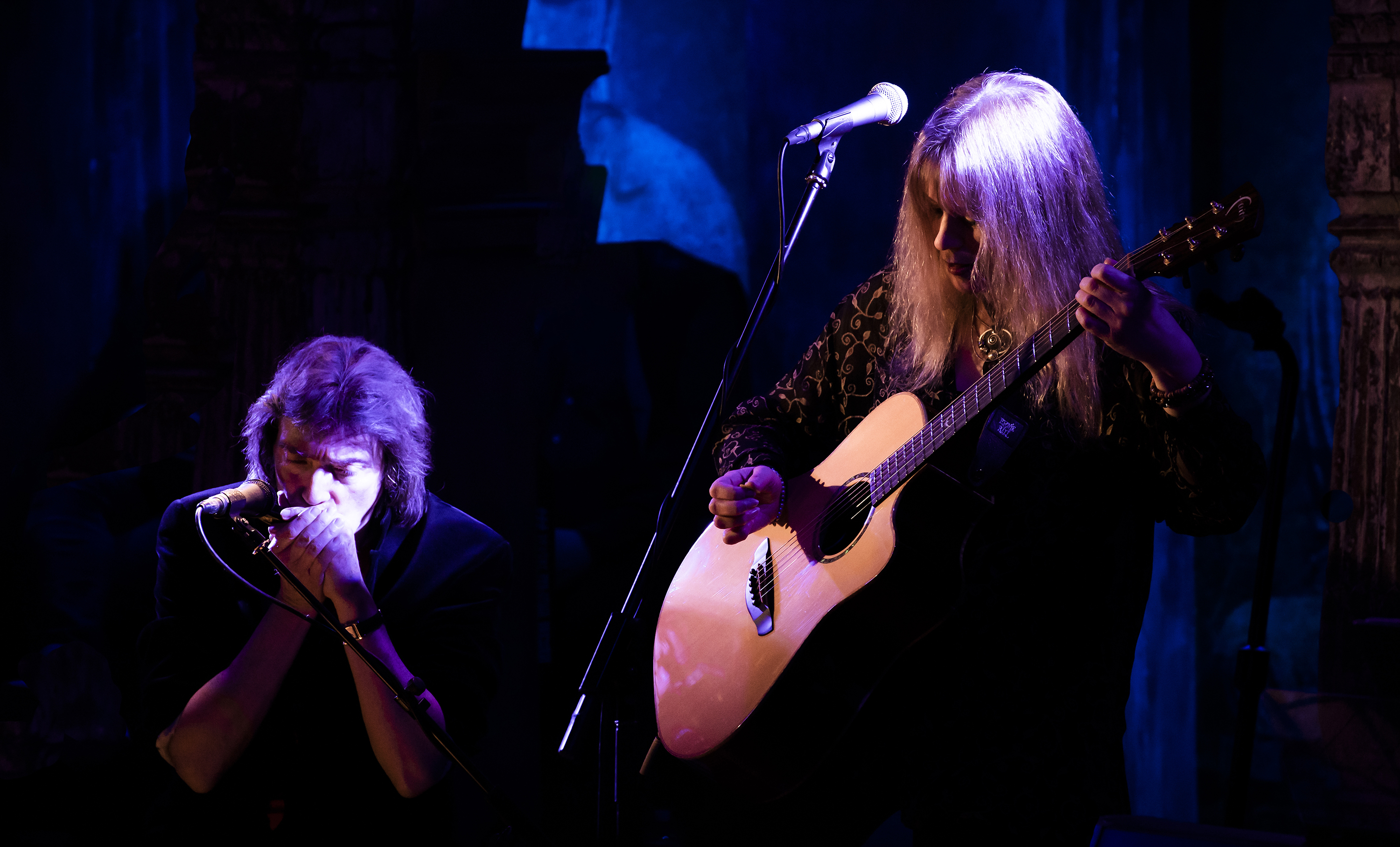 Amanda Lehmann & Steve Hackett | Trading Boundaries | 2019 | Photo by David Clay
Reinforcing the perception that her house is always in motion, videos of newer special projects involving Lehmann have recently emerged on YouTube. For example, a new release by the dark-pop-prog band Random Earth this past March revealed Lehmann providing vocals and guitar on two standout tracks, “Gospel” and “Window”. (Videos for both can be found on YT.) In addition, other artists she has been working with include the Raging Project, the Temple of Switches and – with current Yes bassist Billy Sherwood – a forthcoming project with veteran Chicago-based singer Kurt Michaels.
‘All the musicians [with Random Earth] are a great, very talented bunch,” Lehmann said, noting that she had been invited early on and encouraged to explore different styles of singing. “Although the lyrics were already written, I [had] a lot of freedom vocally with this, and [the tracks] inspired me to try out different vocal styles. For example, [the song] ’Gospel’ required some gospel-style singing, which was both a challenge and a joy. And due to the changing dynamics, the end of that song was a total contrast. I recorded some raunchy, almost grunge-y vocals [for that].”
Free to explore her own songwriting and arrangements on Innocence, Lehmann – who was much more hard-rock leaning in her early career as a guitarist – has proved that she has learned many ‘best practices’ from playing ‘proggy style’ with that recognized master of the form, Mr. Hackett. (In fact, Lehmann also once performed in a Heart tribute band called Reckless Heart around 2015, replicating the role of guitarist/vocalist Nancy Wilson.)
“My learning journey has been a long one,” Lehmann said. “I have countless influences along the way from many excellent – but unknown – musicians. With all this in mind, the years since 2009 (when she and Hackett made their first recording) have also been undoubtedly very important on my musical journey!”
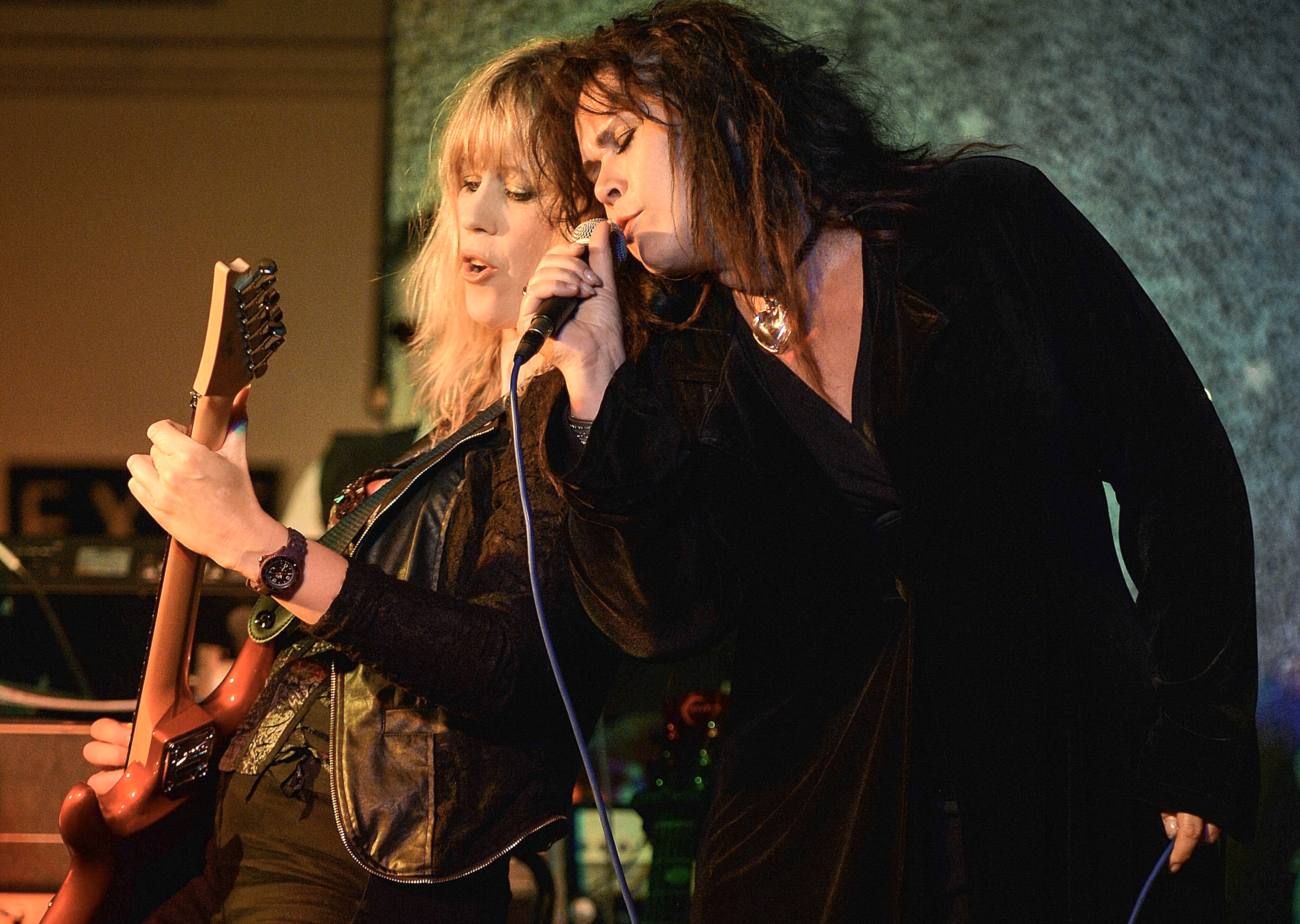 Amanda Lehmann & Lisa Fury in Reckless Heart | 2015 | Photo by Lee Millward
Resolving finally to capture her own musical vision gave Lehmann the focus to develop her vocabulary of evocative lead vocals, layered harmonies, interwoven keyboards, electroacoustic guitar mixes and deftly used dynamics. That combination on Innocence takes listeners on an emotional journey that draws from her own life but also enables them to make new associations and meanings for themselves.
“From my [close] observation of these extremely talented chaps, I’ve [learned the value of] precision,” Lehmann said of working with Hackett’s team. She added that she aims to make her recordings finely crafted, yet strives to keep the organic feel of a live performance. “With my guitar playing, I’m focusing [more now] on vibrato. Guitarists like Steve are masters of that – just the right amount at the right time, for the right length of time. For me, it’s not about ‘shredding’. It’s about control and beauty – making the guitar sing and [mastering] that sound in order to express emotion through the instrument.”
Lehmann confirmed with us that her influences run quite widely. On the male side – among many examples of late-‘70s prog and hard-rock artists – she cited Genesis first. (She has noted that their 1977 album Wind and Wuthering was her personal prog ‘gateway’ as a teenager.) But also, in close formation behind that legendary band, she speaks highly of the Alan Parsons Project, Ritchie Blackmore and Pink Floyd.
“I loved Ritchie Blackmore’s playing from his Deep Purple and Rainbow days,” Lehmann said, praising the hard-rock pioneer’s total mastery of the guitar neck and conceptual approach to playing. “I adore [his] cascading style that moves through harmonic minors.”
With her being a female vocalist, Lehmann also gave shoutouts to such stars as Stevie Nicks, Barbara Streisand, Alison Moyet and Joni Mitchell. She also noted that learning piano as a first instrument and studying Classical music formally have also trained her ear for non-rock textures and forms. So there are obvious progressive and classic-rock influences but also symphonic and soul-jazz sounds blended throughout her sound.
In particular, vocal similarities to those of groundbreaking British singer-songwriter Kate Bush and the Wilson sisters in Heart abound – sometimes arty, others rawk-y, and some just plain pop. But many of the piano- and acoustic-guitar-based pieces blow the music strongly in the direction of Medieval and New Age musical themes. So the tonalities of Enya or Clannad might also come to mind.
With a haunting instrumental intro, melancholy lead guitar lines and her own stacked harmonies, Lehmann opens Innocence with the sweeping progressive-slanted track, “Who Are the Heroes?” Her siren-like vocals, the Wishbone Ash-like harmonized lead guitars and the martial drum beat all build toward an art-rock crescendo, conveying a sense of yearning, a call for humanity to lean into loving service to each other. That keening theme raises great expectations for the rest of the album from the start. And, yes, that theme continues, but many surprises and personal revelations await.
Interestingly, Lehmann paces the album with a mix of lighter songs of varied styles between the few straight-on rock tracks. For example, the second song up after that commanding opener is a wistful, romantic ballad called “Tinkerbell”. As the name suggests, this is a song dipped in magic and fantasy, and it carries a wafting fragrance of late-‘70s Renaissance or contemporary Celtic pop-rock music.]
Another early change-up before we get a nice, full chunk of that old-school prog that we know must be on there is a surprise appearance by the Talented Mr. Hackett. (This is the first of his three guest appearances on the album.) Interestingly, on this track, “Only Happy When It Rains”, there’s no trace of Hackett’s stellar guitar playing. Instead, he shines through darkly as an awesome blues harp player. His harmonica lines dart around Lehmann’s torch-y, Joni vocals and Rob Townsend’s alto sax lines over a witchy, jazz-club groove, like a yowling cat in the night.
The first track that plunges the listener into deeper prog waters early in the album – and this writer’s personal favorite – is “The Watcher”. Initially, the bleak, brooding piece unfolds as a cautionary tale about restraints and repression of all kinds but then explodes with a fiery middle section before the final chorus. Unlike her treacly vocals on an earlier ballad, her narrative voice takes on a more weathered and warning tone here, sounding much like the huskier vocals of, say, a latter-day Marianne Faithfull.
Instrumentally, the dynamics on this track also show Lehmann taking cues from such rock guitar luminaries as Mark Knopfler and David Gilmour. The opening has smoky blues fills over a spare arrangement with her astringent vocals. Then, after a brief burst of hot guitar between the verses and choruses, she breaks into a fiery, mid-song Phrygian-modal guitar solo with climactic key modulations before landing like a feather at the quiet beginning of the final verse. And for anyone who has been living under a progressive rock as I have, that kind of dramatic harmonic shifting is always mighty powerful catnip!
Another subdued interval follows with the poignant “Memory Lane,” a lament about the passage of time and the loss of memories. This leads into a full-on, arena rocker – if Lehmann should ever graduate to the arena circuit, this is one would be a no-brainer for the setlist – called “Forever Days”. With a driving, riff-based rhythm and a triumphant melody that calls to mind early ‘80s Pat Benatar and Renaissance (Imagine that!), this track matches Lehmann and Hackett in a grunge-y, guitar duel. And it’s a perfect showcase for both guitarists’ more metallic chops.
From there, the album ends up with a three-song series of wistful-but-hopeful romanticism that include the Peter Gabriel-meets-Kate Bush anthem to the dignity of elephants “We Are One”, the enchantingly bluesy “Childhood Delusions” and the floating outro “Where the Small Things Go.” In particular, the latter piece is a short, Classical-guitar ballad, co-written by Lehmann and Hackett. After reaching some truly soaring, mid-album moments, Lehman’s sweet finish with Hackett’s distinctive nylon-string touch seemingly helps the listener to reorient, as if waking refreshed from a long, active, technicolor dream.
Although Hackett and his keyboardist Roger King and sax/clarinet/flute man Rob Townsend all play prominent roles throughout the album, it seems that Lehmann has another secret weapon on board. And that would be Nick Magnus, a longtime Hackett collaborator from the guitarist’s earliest solo albums in the late-1970s.
Primarily a keyboardist, arranger and engineer, but also an artist with his own track record of releases, Magnus worked with Lehmann to develop several of her Innocence tracks from working demos that she recorded in her home studio, she explained. And he provided some supplemental keyboards – including Mellotron, which is all over the album – to her primary piano parts. He also built up all of the rhythm tracks from electronic drum samples and scored the full orchestral arrangements. This resulted in many of the ballads having a lush, cinematic feeling.
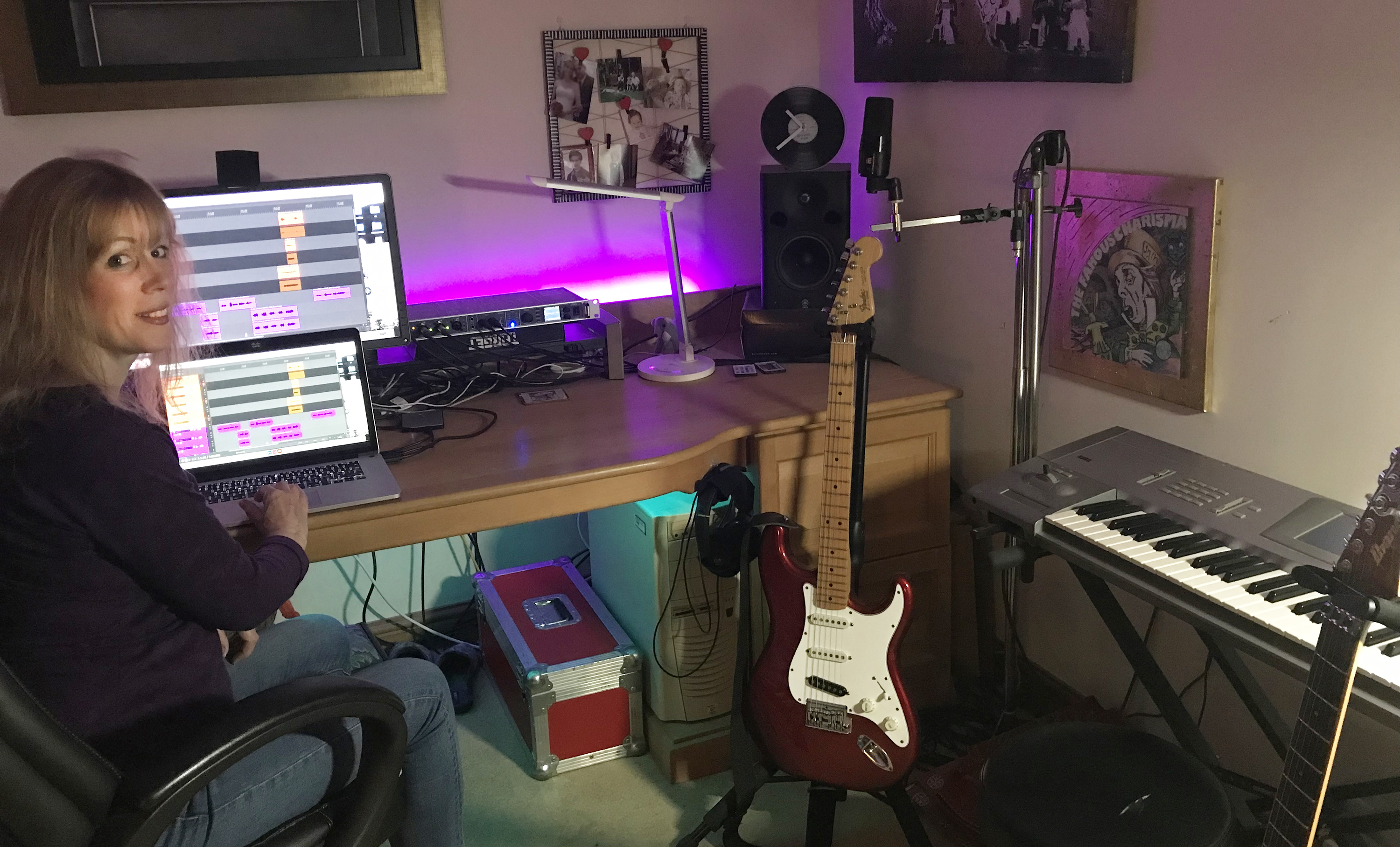 Amanda Lehmann in her home studio | Photo courtesy of Amanda Lehmann
Magnus’ agility with the drum programming is most impressive. Obviously, in the hands of a lesser technician, such full-band songs as “The Watcher” and “Forever Days” would lack the critical feel and reactions of a live drummer in the room. The really amazing part is that if the credits didn’t tell us, we’d never know otherwise from the in-the-pocket performances of all the musicians!
In keeping with Lehmann’s own descriptions of them, the songs of I&I clearly reflect a person’s journey through life, with joys and disappointments, misunderstandings and clarifications, conflicts and resolution. The songs themselves, she has noted, were not written all in one batch but over a wider range of time, and the emotional shifts in the songs convey some changing points of view that come with experience and maturity. And perhaps looking at the album as a kind of diary of Lehmann’s life helps to bring it all into focus: Older and wiser but still in love with life and very much believing in magic.
As Lehmann has explained elsewhere, she had written some songs – such as “The Watcher” – even much farther back in time but revised them in more recent years. Also, she and Magnus started assembling the tracks in 2019, and the project quickly gathered steam. Unfortunately, the Covid lockdown came along the next year and put a chill – but, luckily, not a complete freeze – on the recording process. A second burst of post-lockdown activity followed, however, with Lehmann and Magnus working remotely from each other and exchanging digital files for the final arrangements and mix. And then Lehmann finally delivered the lovingly polished gem in August 2021.
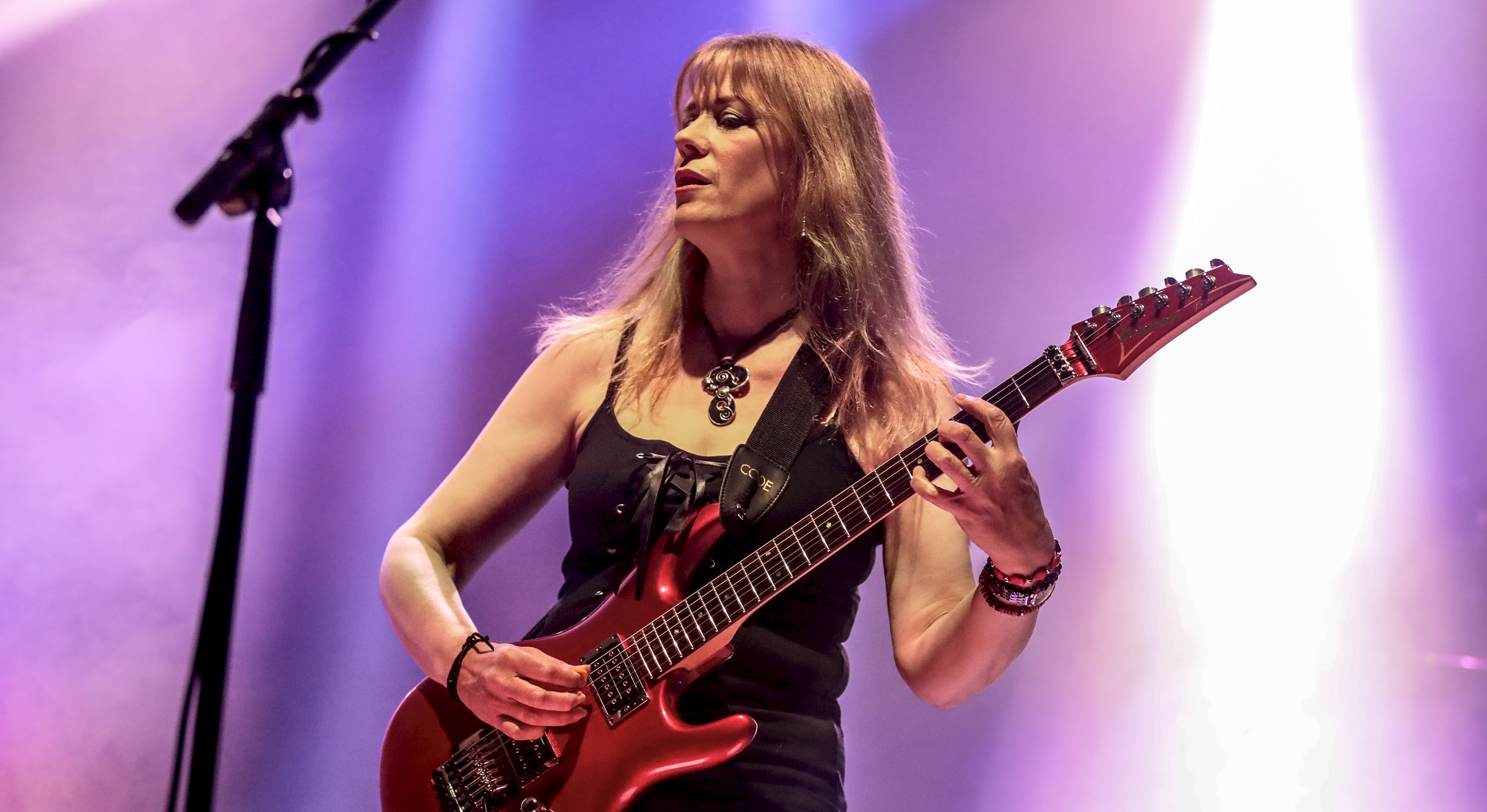 Amanda Lehmann Live | with "Red" | Photo by Mick Bannister
Having gone back to Innocence and Illusion many times now, I always find myself marveling at how much more centered and in focus I feel after listening to it. My perception is that Lehmann offers the world a hopeful, uplifting outlook and the healing power of music at a time when the world needs that most.
Looking ahead to her next recording, Lehmann confirmed it is shaping up and that listeners can expect a similar mix of extended epics and reflective pieces.
“Creating the ‘follow-up’ is always a challenge,” she said, noting that she sees it as a chance to try some new ideas. “As with I&I, [her next] album won’t exactly be a concept album but it will have a theme. Also, different musical genres – whatever suits the songs the best. And, as always, I’ll indulge in multi-layered vocals, guitars and some piano as well.”
In light of all this, it will be very interesting to hear what Lehmann paints for us with her colorful musical palette next time around. In the mean time, my very best advice is to make time to allow yourself to submerge fully as you listen to I&I, to go with the flow of Lehmann’s dream, and then to make up your own mind about what is real and what is an Illusion.
Website: www.amandalehmann.co.uk/
Facebook: https://www.facebook.com/AmandaLehmannMusic
Twitter: @amandalehmann25
Instagram: https://www.instagram.com/amandalehmannmusic/
VIDEO LINKS:
Additional Innocence & Illusion Single:
Memory Lane
https://www.youtube.com/watch?v=Je6M8ncIBJ4
Collaborations/Features:
Random Earth Project: Window (Feat. Lehmann lead vocals, guitar solo)
https://www.youtube.com/watch?v=7rX8Q7TnaRc
The Raging Project: Procession [Excerpt] (Feat. Lehmann guitar solo)
https://www.youtube.com/watch?v=m1jPWcl2lmo
Temple Of Switches: The Wind (Feat. Lehmann lead vocals)
https://www.youtube.com/watch?v=gW77Wrb_vXE
Kurt Michaels: Relax… Nothing’s Under Control (Feat. Lehmann lead & backing vocals)
https://www.youtube.com/watch?v=bpmgBHQJZ4o
Steve Hackett & Genesis Revisited videos (a selection):
Shadow Of The Hierophant (Live Hackett solo song)
https://www.youtube.com/watch?v=3vKVTYiCx5w
Fifty Miles from the North Pole (Hackett solo song from 2019)
https://www.youtube.com/watch?v=BjW6JLXu7wQ
Entangled (Genesis cover, Feat. Lehmann lead vocal)

It’s tempting to call Steve Hackett’s latest release, “Live Magic at Trading Boundaries” an “unplugged” album. But that’s not quite correct. Yes, Hackett & Co. are largely playing acoustic instruments, in stripped-down makeovers that cut the original full-band arrangements to the core. But, in fact, “Live Magic” would be better described as Hackett “unbound,” with nearly all of the 19 live tracks on the album untethered from their original plugged-in versions and reworked to include newly written material.
Before delving into the particulars of this stellar addition to the Hackett canon, a little background is in order.
Hackett has been playing annual winter acoustic concerts at Trading Boundaries in Sussex, U.K., for years. These intimate shows allows the ex-Genesis guitarist to deliver uniquely reimagined highlights from his 50-year-plus career, while also showcasing his classical side. “It’s always a joy for me to play at Trading Boundaries, a magical intimate place full of beautiful lights and exotic imagery, illuminating the darkest time of year over Christmas and New Year,” he says. “It’s the perfect location for my acoustic set.”
The new album is a compilation of high points from his winter acoustic shows. It features regular Hackett collaborators Roger King on keys, Rob Townsend on flute and saxophone, brother John Hackett on flute and sister-in-law Amanda Lehmann on guitar and vocals. But the album is so well paced and constructed it plays like a single concert, anchored and driven by Hackett’s widely varying catalogue and virtuosic fretwork.
Over the course of an hour, Steve performs a series of dazzling nylon-string solo guitar pieces and leads his supremely talented co-conspirators through a dizzying trek through his kaleidoscopic musical portfolio. Along the way, the crew also tackles a few classical music pieces and ladles in a few other surprises. As always, Hackett manages to pick some of the best compositions from his with Genesis days and since leaving the band to go solo in 1977. And, the truth is, some of these new acoustic arrangements rival the original full-band performances.
The album opens with Hackett delivering five solo acoustic pieces on nylon-string classical guitar that collectively hold together like a five-part mini concerto. The first piece is an introductory improvisation that showcases Hackett’s fiery fingering technique — a marriage of mathematical precision, songcraft, bone-deep soul and fluidity. Next up is the acoustic introduction to “Blood on the Rooftops,” from the 1976 Genesis classic “A Trick of the Tail,” capped by a glorious newly written outro that replaces the vocal/band performance that followed the intro on the original. Hackett follows it up with “The Barren Land” and “Blacklight” —two haunting beauties from his 1983 classical guitar album “Bay of Kings” — and “Horizons,” the familiar Bach-like etude from the 1972 Genesis album, “Foxtrot.”
After this lovely five-part overture, the band joins Hackett to play the effervescent “Jacuzzi,” from Hackett’s 1980 “Defector” album, incorporating a new flamenco guitar-driven interval. A mini-Genesis suite follows. It opens with the pastoral flute-guitar interlude from “Supper’s Ready” that precedes the cacophonous “Apocalypse in 9/8” break. Next, the band reprises “After the Ordeal,” the lone instrumental from 1973’s “Selling England by the Pound” and the guitar-piano duet from “Hairless Heart” (a highpoint of 1974’s “The Lamb Lies Down on Broadway”), which showcases yet another newly improvised section that takes the piece in an entirely novel direction.
Hackett then shifts gears and leads the band through the Latin-flavored “Jazz on a Summer’s Night,” from 2017’s “The Night Siren,” before dueting with brother John on “Gnossiene No. 1,” the jaunty flute-guitar duet that graces the Hackett brothers’ 2000 “Sketches of Satie” album, a tribute to French minimalist composer Erik Satie. “Walking Away From Rainbows,” from 1993’s “Guitar Noir,” follows before Hackett and friends launch into a striking excerpt from Francis Poulenc’s 1938 “Organ Concerto” (merging gothic churchy organ soundscapes with free-form jazz improvisations) and “The Red Flower of Tachai Blooms Everywhere,” the Asian-influenced mood piece from “Spectral Mornings.”
What comes next is the high-water mark of the album and perhaps Hackett’s entire solo career — “Hands of the Priestess,” from Hackett’s first solo album, 1975’s “Voyage of the Acolyte,” released while he was still on the Genesis payroll. In a satisfying reworking of the piece, Hackett has condensed the three-part suite to just two sections — merging the opening and closing acoustic segments into a single all-of-a-piece track and resecting the discordant electric middle interval that divided them on the original triptych. With only a few additional bars of new orchestral music stitching it all together, the new “Hands of the Priestess” is as strong and arresting a musical statement as the original, if not more so. Flute, sax, guitar and synthesizer lines merge, twist and join together like four rippling streams flowing into a moonlit lake.
Two surprises follow: A couple tracks from Lehman’s excellent 2021 solo album, “Innocence and Illusion,” which features Hackett, King and Townsend. “Memory Lane” is a poignant lament about her mother’s dementia, helmed by her enchanting voice. “Only Happy When It Rains” is a cabaret-style torch song, with Lehman delivering a sultry, late-night-jazz vocal and Hackett playing a funkified swamp-blues harmonica intro.
Another highlight of the album is next: “Ace of Wands,” from “Acolyte,” reworked so magnificently as a chamber-rock orchestral piece that it rivals the rockier original. The album then closes out with “The Journey,” the atmospheric classical-guitar etude from “Bay of Kings.” The upbeat piece ends the album on a high note, bringing the proceedings full circle with a satisfying conclusion that echoes the five-part nylon-string series that opened the record.
With such a wide variety of boundary-blurring musical styles — folk, prog, jazz, classical, cabaret and even world beat music — it would be difficult to imagine a more aptly named venue for the performances collected here. Also worth noting: Several pieces on “Live Magic” sound more like brief snippets or transitional interludes than fully realized works. But most tracks include newly written sections that elevate them and let them stand on their own. A handful even surpass the originals.
The result: “Live Magic” is a satisfying retrospective of Hackett’s long and distinguished career, with these new acoustic retreads sounding fresh and new, collected like a musical jewelry box of rare gems.


 Posts
Posts


