Showing posts with label 40th anniversary. Show all posts

19 Feb 2013: King Crimson and Peru

The 40th Anniversary Edition featuring a new stereo mix from the master tapes by Mr. Steven Wilson. Larks' Tongues in Aspic is the fifth studio album by the English progressive rock group King Crimson, originally released in 1973. This album is the debut of King Crimson's third incarnation, featuring original member and guitarist Robert Fripp and new members John Wetton (vocals, bass guitar), David Cross (violin, Mellotron), Jamie Muir (percussion), and Bill Bruford (drums). Bruford had just left Yes before they embarked on their Close to the Edge tour. Bruford felt that he had done all he could with Yes at this point and thought the more jazz-oriented King Crimson would be a more expansive outlet. (Wikipedia) 

Peru are a Dutch electronic group, consisting of three core members, augmented by a fourth in recent releases. Continents, Points of the Compass, and Forlian are their 3rd, 4th, and 5th releases respectively, and are very representative of the group's formative years. They have, to date, released 6 albums, all of which are available on CD. Continents, released in 1983, consists of five tracks, two of which exceed 10 minutes in length, seemingly influenced by Klaus Schulze of the late seventies/early eighties, with melodic arpeggios over minor chord backing, and then breaking out into the fuzz-guitar-like leads that Tangerine Dream used in the mid-to-late-seventies. Their influences are quite apparent, but the music is enjoyable in its own right. I should also point out that the first track sounds as if it would be at home on Double Fantasy's "hit," Universal Ave., and, in fact, similarities to that release show up at various points. Points Of The Compass was released in 1986, and showed a progression from Continents, in the use of more varied song structures and synth timbres. The music is similar in style to Tangerine Dream of the mid-eighties, circa Le Parc, and possibly the "Heartbreakers" soundtrack. The pace is much more uptempo, and melodic, making this probably the most accessible of the Peru releases. In 1988, Peru released Forlian, which combined the accessibility of their previous release with a slightly subdued mood, with a result that is reminis- cent of some of Johannes Schmoelling's solo works. This will be an enjoyable disc for those who like Schmoelling, and, to some extent, the early eighties version of Tangerine Dream. (Gibraltar Encyclopedia of Progressive Rock)
Label:  Red Bullet ‎– RB 66.70     Country: Netherlands     Released: 1993
Genre: Electronic   Style: Trance

Tracklist 

1
Book Of Revelation 14:26
2
666 (The Beast) 7:52
3
Guru 7:29
4
Nostradamus 8:15


5  Not Consequent
Written By – Peter Kommas
7:03


6  The Prophet
Mixed By – Rob Blanchemance
9:29
7
Nostradamus (Club Version) 4:30
8
Book Of Revelation (Radio Version) 4:04

Credits▼


Notes▼


Except Track 5 was written by Ruud van Es, Peter Kommas & Rob Papen.
Tracks 7 & 8 are Bonus Tracks.

27 November 2012: Emerson, Lake, and Palmer 40th Anniversary Releases

New remixes by (who else) Mr. Steven Wilson.

Emerson, Lake & Palmer, also known as ELP, are a sporadically active English progressive rock supergroup.[1] They found success in the 1970s and have sold over forty million albums[2] and headlined large stadium concerts. The band consists of Keith Emerson (keyboards), Greg Lake (bass guitar, vocals, guitar) and Carl Palmer (drums, percussion). They are one of the most popular[3] and commercially successful progressive rock bands.
The ELP sound is dominated by the Hammond organ and Moog synthesiser of the flamboyant Emerson. The band's compositions are heavily influenced by classical music in addition to jazz and – at least in their early years – hard rock. Many of their pieces are arrangements of, or contain quotations from, classical music, and they can be said to fit into the sub-genre of symphonic rock. However, Lake ensured that their albums contained a regular stream of simple, accessible acoustic ballads, many of which received heavy radio airplay.[4] Lake, besides providing vocals, bass guitar, electric guitar and lyrics, also produced the band's first five albums.

Their debut album was simply titled Emerson, Lake & Palmer, and was released in late 1970. It was mostly a collection of solo pieces. Keith Emerson contributed a series of treatments of classical pieces (such as Bach's French Suite No. 1 in D minor, BWV 812 and Bartok's 'Allegro Barbaro'), Carl Palmer provided a drum solo (called "Tank") and Greg Lake provided two ballads, beginning with the folky, extended work "Take a Pebble". It was the ballad, "Lucky Man", which was a song Lake wrote when he had his first guitar at the age of 12,[18] that brought the band to prominence. It received heavy radio play in the UK and Europe, and also became a surprise hit in America.[19] The commercial success of "Lucky Man", combined with a strong performance at the Isle of Wight festival (released on CD in 1997 as Live at the Isle of Wight Festival 1970), brought ELP rapidly to prominence.
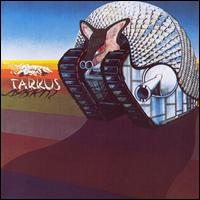
Tarkus, released in 1971, was their first successful concept album, described as a story about "reverse evolution". Combining a side-long song with an assortment of hard rock songs, an instrumental and even some comic songs, it was quickly cited as landmark work in progressive rock. The epic "Tarkus", recorded in just 4 days, is a seven-part rock suite which incorporates a number of complex time signatures. The breadth and complexity of the music combined with the series of William Neal paintings incorporated into the sleeve art helped to cement ELP's reputation as being on the forefront of progressive rock music.