Please support FreeForm Radio and KMXT by going to www.KMXT.org and pledging your support.
The music you hear tonight is available on the artists' Bandcamp pages and websites and Spotify.
This
is the project that our performance at Echoes in 2017 inspired. Vin,
Jeff, and I decided to see what would happen if we let ourselves wander
together into the music. We gathered at my studio with no preconceptions
about what we were going to play. I had some ambient loops prepared,
and we picked a few to give us landscapes to play into... and then we
just explored and responded to each other in the moment. I love how it
turned out... and I particularly love that Vin played electric guitar
and was completely at home with the slow drift that Oster and I have
spent so much time in. Hope you love it!
Seven Conversations
A
shimmering blend of Jeff Oster’s liquid Flugelhorn, Vin Downes’ dreamy
electric guitar, and Tom Eaton’s watercolor touch on keyboards and bass.
At times soft and emotional, at times driving and propulsive, the album
explores deeply ambient territory across seven in-studio
improvisations.
From the liner notes:
"my admiration for tom and vin as musical artists is exceeded only by my
appreciation of their wry humor. sometimes laughter comes from the
deepest places, just like this music."
- jeff oster
"an indescribable alchemy happens when good friends create music
together in the moment. words are unnecessary. these musical
conversations capture that magic so well."
- vin downes
"we chose a key and one of us began. nothing written, no safety net. the
real trick to improvising in a group is not the playing, it's the
listening, and these are two of the very best listeners out there."
- tom eaton
credits
released April 26, 2024
FreeForm thanks Tom Eaton for providing us with a copy of this excellent release.
all songs written and performed by
jeff oster (ascap)
vin downes (bmi)
tom eaton (bmi)
The Lloyd Webber brothers were always very close but their two different careers (a rock musicalcomposer and a classicalcellist) meant that a collaboration seemed unlikely. It was not until Julian beat his brother in a bet on a Leyton Orientfootball match that Andrew was forced to write his cello work.
"Stalker"
is Eighth Tower's tribute to the cinematic masterpiece "Stalker" (1979)
by Russian director Andrej Tarkowskij. Tarkowskij 's second science
fiction film after Solaris, "Stalker" is based on a novel by the
Strugackij brothers, Arkadij and Boris, renowned authors of Soviet
science fiction. The novel, titled "Roadside Picnic," was released in
1971. Tarkovskij adapted the basic literary work, written in the form of
dispatches and intelligence reports, inspired by the Tunguska event of
1908—a probable impact in a remote Siberian area of a meteorite or
possibly a comet. This collision, still the subject of studies and
controversies today, in the 1970s generated a series of pseudoscientific
hypotheses akin to a pre-Roswell event, based on the suggestion that
the mysterious crashed object was an extraterrestrial spacecraft.
The Zone is primarily the interior of a rural territory that has been
disrupted by an unspecified event, perhaps the fall of a meteorite or
the passage of an extraterrestrial spacecraft. Within it, strange and
mysterious events occur, and many people have disappeared. Above all,
there is a rumor that a "Room" capable of fulfilling any desire is
located within the Zone. After attempting to study the Zone, the
military evacuated the population and restricted access.
Scholars need special permits to enter. Only the Stalkers, guides who,
for money, accompany anyone willing to try to reach the Room of Desires,
challenging the authorities, venture into that territory. The film
follows the journey of one of them. The man, a father of a legless
daughter, despite his wife's opposition, decides to bring a failed
writer in search of inspiration and a professor driven by scientific
curiosity into the Zone. Three unnamed characters who seem to represent
faith, art, and science.
The world of "Stalker," filmed in Estonia, Russia, and Tajikistan, is a
science fiction of inner space, reminiscent of Ballard, a dreamlike
space. Leaning light poles, debris, abandoned huts. The film's world is
heavily degraded and contaminated by trash, debris, and wreckage. A damp
world, flooded, with puddles and rain. A disturbed world of a
civilization now in a state of post-industrial decay, continually
punctuated by the "dodeskaden," the noise of trains and their
vibrations. If we remember the Soviet Union, which would eventually have
its forbidden and radiation-contaminated zone around the nuclear
disaster of Chernobyl, then we can say that Tarkovskij was prophetic in
outlining that degraded landscape with the reactors of a nuclear power
plant in the background.
Everyone will form a different idea while watching Stalker, but everyone
will be left with the impression of having witnessed a work of art,
thanks to the emotion that the images and dialogues manage to evoke.
After all, art is, above all, emotion.
"The Zone is the Zone, the Zone is life: crossing it, a person either
breaks or resists. Whether a person will resist depends on their sense
of their own dignity, their ability to distinguish the essential from
the transient."
— Andrei Tarkovskij.
In this compilation of musical tracks and soundscapes, Eighth Tower
Records and the musicians involved in the project pay passionate homage
to this masterpiece of science fiction cinema and, more broadly, the
history of cinema.
The cd is accompanied by a beautiful anthology of unpublished stories
by: B. E. Dantalion, Andrew Coulthard, Chris McAuley, J. Edwin Buja,
Glynn Owen Barrass, Michael F. Housel, Nora B. Peevy, Sarah Walker.
Mark Hjorthoy
Eighth Tower Records is responsible for turning me on to movies I had
never heard of before. How many music labels can boast that? Their
latest delves into a movie called ‘Stalker‘ by Andrej Tarkowskij – a
1979 Russian sci-fi thriller, that has a huge cult following. The tracks
included on this release bring the chills and fear associated with the
plot brilliantly, and leave you feeling like you’ve just lived through a
harrowing experience. Post-apocalyptic brilliance shines hard on this
album. A perfect representation of a long-loved creative masterpiece.
This is a huge winner from a great label. I’m going in for another
listen.
Music by: Cult Of Light, Rapoon, Mombi Yuleman, Tsath, phoanøgramma,
Mario Lino Stancati, Esa Ruoho, Kelados, Morgen Wurde, vÄäristymä,
Zabbaleen, Yousef Kawar, Glacial Anatomy.
The music has its roots in earlier subgenres like Western, honky tonk, rockabilly and progressive country, and is characterized by a blend of rock and folk rhythms, country instrumentation and introspective lyrics.[3][4] The movement began as a reaction to the slick production and limiting structures of the Nashville sound developed by record producers like Chet Atkins.[3][5]
Origin of term
The
movement was named, at various points, "redneck rock", progressive
country, or "armadillo country", after the animal which would become the
movement's unofficial mascot, before it was termed "outlaw country".[1] The origin of the outlaw label is debated. According to Jason Mellard, author of Progressive Country: How the 1970s Transformed the Texan in Popular Culture, the term "seems to have sedimented over time rather than exploding in the national consciousness all at once".[10]
The term is often attributed to "Ladies Love Outlaws", a song by Lee Clayton and sung by Waylon Jennings on the 1972 album of the same name.[11]
Another plausible explanation is the use of the term a year later by
publicist Hazel Smith of Glaser Studios to describe the music of
Jennings and Tompall Glaser. Art critic Dave Hickey, who wrote a 1974 profile in Country Music magazine, also used the term to describe artists who opposed the commercial control of the Nashville recording industry.[10]
In 1973 Jennings produced Lonesome, On'ry and Mean. The theme song was written by Steve Young, a songwriter and performer who never made it in the mainstream, but whose songs helped to create the outlaw style.[citation needed] The follow-up album for Jennings was Honky Tonk Heroes and the songwriter hero was Texan Billy Joe Shaver. Like Steve Young, Shaver never made it big, but his 1973 album Old Five and Dimers Like Me is considered a country classic in the outlaw genre
Instrumental intergalactic travellers Ozric Tentacles return with 6
new tracks constructed in their very own blue bubble for new album Lotus Unfolding
Opening track Storm in a Teacup is wonderfully familiar of which I feel that I am transported back to the groups Jurassic Shift era with soundscapes incredibly reminiscent of when I discovered them in my teenage years back in the mid 90’s.
it’s one of the albums longest tracks but is so varied and
well-structured that the entrancing waves feel that no real time has
passed.
The first time I listened to this album was in the stillness of the
night in complete darkness and because of this became engulfed in follow
up track Deep Blue Shade
Halfway point of the album opens up for the albums title track Lotus Unfolding
which is deeply hypnotic and easily my highlight track of the release
it has a real calming presence with prominent bass and swirling solo’s
which is then complimented by the albums longest track the majestic near
10-minute chaotic nature of Crumplepenny
The albums final duo really hone in on the quintessential essence of
Ozric Tentacles journey through planes of melodies and musicianship Green Incantation is a wonderful blend of experience and experimentation with the album final venture Burundi
Spaceport end this particular chapter with an air of hypnotic serenity
sprinkled with just a dash of showmanship and artistic flair.
The concept is, as usually wide & open to interpretation but
basically is a sonically illustrated excursion through some of the
musical realms we found ourselves in this time around.
Designed to elevate and delight the senses, should that be
required, because if the day feels like an unfolding lotus, it’s
probably going to be a good one!
A rather splendid astral journey via the aural senses.
Smallcreep's Day is the first studio album by English guitarist and songwriter Mike Rutherford, released in February 1980 on Charisma Records. It was recorded in 1979 during a period of inactivity from his rock band Genesis, during which Rutherford and keyboardist Tony Banks recorded their first solo albums. The 24-minute title track is based on the 1965 novel Smallcreep's Day by Peter Currell Brown which tells the story of Mr. Smallcreep and the journey of self-discovery he takes through the assembly line of the factory he has worked in for forty years.
Rutherford played all lead and bass guitars on the album which included an acoustic 6-string Ovation, an electric 12-string Alvarez, his custom made Shergold double neck bass, a Fender Stratocaster for lead parts, an Ibanez,[3] and a Rolandguitar synthesiser, from which he acquired a string sound that reminded him of a Polymoog synthesiser.[5][3] He also borrowed a few models from a keyboard roadie who was an avid guitar collector.[2]
Smallcreep's Day opens with the 24-minute title track that has seven distinct movements.[5] It is based on the 1965 novel Smallcreep's Day, the only book written by Peter Currell Brown.[5]
A satire on modern industrial life, the story follows Pinquean
Smallcreep who has worked in the same factory for forty years and
embarks on a journey of self-discovery as he follows its assembly line to find out what the factory produces.[4] Brown had in fact worked in a factory for forty years himself.[3] Rutherford had read the book roughly three years prior to starting work on the album, noting it had similarities to the Gormenghast series of fantasy novels by Mervyn Peake.[1]
Though he considered it "hardly a great piece of literature", he was
more impressed with its spirit and the atmosphere it presented as a
reader.[7] He also chose the book as its story and setting were something he could work and develop from and adapted it to have a happy ending.[1][8]
He later noted a strong contrast in themes between the factory and
machine-oriented imagery on his album and the more romantic and
fantasy-inspired Genesis songs typical of the time.[3] Rutherford had attempted to pass lines from the book as lyrics, but abandoned the idea as they failed to work effectively.[3]
Next in the quiet details series
we have something very special - an incredible interpretation from the
musician and visual artist, øjeRum.
Loved for his music as much as his stunning collages, øjeRum has a deep
back-catalogue of releases spanning labels such as Room40, Opal Tapes,
Fluid Audio and many more - all exploring his unique minimal and deeply
textural style.
With En Sten for Solen (A Stone To The Sun, translated from his native
Danish) we find an album which builds on his already finely-honed
sensibilities and creates an emotive and introspective journey through
his refined creativity.
Beginning with what feels like rhythmic footsteps into the immersive
worlds he’s so adept at conjuring, you quickly fall deeper into these
mesmerising and all-encompassing narcotic soundscapes.
Gaseous clouds mix with disintegrating melodic phrases, beautifully designed auditory illusions come in and out of focus - all perfectly paced and subtly shifting as time goes on and the music draws you further in.
This music, like his artwork, has an almost mystical feeling, verging on
the supernatural - it’s timeless and has a way of speaking to people
regardless of background or culture - it’s purely human and moving
beyond words.
The production is as we’ve come to expect from øjeRum - dense yet soft,
with bright rays of light beaming through the nebulous mist.
Living up to his reputation as an artist that traverses media with great
skill, along with the album he wrote these poetic words:
I hold a stone to the sun / so I cannot see
the sun for the stone / but only its outline
that vibrates and shapes / the stone bigger and smaller
organic and graceful as / an angel in the snow
until the point where / the stone seems to disappear
too real to be / real and / now I hold the sun
the sun for the stone / and the angel in the snow
is dancing with the sun / in the stone
Huge thanks to øjeRum for everything, a truly complete and wonderful addition to the series.
The artwork was made as always influenced by the music and idea behind
the album - this time it was very special as øjeRum is so well-know for
his visual art - he gave me the honour of using one of his original
collages to use as the basis of the piece - which was then captured with
analogue photography and processed here at quiet details studios.
We’re both very happy with the results and so pleased to share it with you.
Our thanks to Alex at quiet details for providing us with a copy of this release.
øjeRum - A Stone To The Sun
1 The Sun’s Light Behind My Eyelids
2 A Hundred Years From Now
3 When Bodies Of Glass Contract
4 Out Crawls The Day
5 Under The Dream
6 A Stone To The Sun
Dragon are a New Zealand rock band which was formed in Auckland in January 1972,[1][2] and, from 1975, based in Sydney, New South Wales, Australia. The band was originally fronted by singer Graeme Collins, but rose to fame with singer Marc Hunter[3][4] and is currently led by his brother, bass player and co-founder Todd Hunter.[5] The group performed, and released material, under the name Hunter in Europe and the United States during 1987.
Dragon formed in Auckland in January 1972 with a line-up that featured Todd Hunter on bass guitar, guitarist Ray Goodwin, drummer Neil Reynolds and singer/pianist Graeme Collins.[19][5] All had been in various short-lived bands in Auckland, and Collins is credited with using I Ching to provide the name Dragon. Their first major gig was an appearance at the Great Ngaruawahia Music Festival in early January 1973.[8] By 1974 several personnel changes had occurred, with Todd Hunter's younger brother, Marc Hunter, joining on vocals and Neil Storey on drums.[19][5] The band recorded two progressive rock albums in Auckland, Universal Radio in June 1974 and Scented Gardens for the Blind in February 1975 both on Vertigo Records.[19][5][20] Despite being one of Auckland's top live attractions by late 1974,[19] neither albums nor related singles had any local chart success,[19] and they recruited Robert Taylor (ex-Mammal) on guitar as they searched for a raunchier pop sound.
1974 Vertigo
Side 1
"Universal Radio" (Goodwin, M. Hunter, Thompson, Storey, T. Hunter) - 8:33
"Going Slow" (T Hunter) - 6:16
"Patina" (Goodwin, (Break Dragon)) - 11:47
Side 2
"Weetbix" (Goodwin, T Hunter, Bedgegood, Abbot) - 2:55
"Graves" (Goodwin, T Hunter, Reynolds, Thompson) - 6:56
"Avalanche" (Goodwin, T Hunter, Reynolds, Thompson) - 11:08
Mutant vegetables, schizophrenic spoken word passages, and a
didgeridoo bump into each other on the second album from the
genre-warping trio of Nick Beggs, Adam Holzman and Craig Blundell.
Musically speaking, The New Normal picks up from 2021’s Fragments,
offering listeners a high-spirited blend of groovy fusion and
experimental prog delivered in easily digestible bite-sized servings.
Where
most albums in the fusion world tend to feature longer tracks that
allow plenty of time for expansive soloing, there’s a clear sense of
discipline here. While The New Normal is a double album for those
experiencing it on vinyl, the tracks are the length of pop songs, barely
stretching over four minutes for the very longest.
Consequently,
there’s never any danger of an idea outstaying its welcome or a musical
motif being dissected until any trace of the original melody has long
since vanished.
What’s noticeably different this time compared to Fragments
is the greater prominence of Beggs’s voice. The majority of the music
remains instrumental, yet he sings several tunes, bringing a heartfelt
tenderness to the ballad Once Around The Sun, and a satirical sensibility to Stupid Pop Song.
The album is punctuated by spoken interludes in which Beggs argues with
himself, playing either siblings or perhaps two sides of his own mind,
debating who’s the better didgeridoo player in Sibling Rivalry and trying to escape himself in What Are You Doing.
There’s more surreal humour in Stroboscopic Fennel which brings to mind Frank Zappa, Paul Gilbert’s 2012’s album Vibrato, or some of Stewart Copeland’s wackier compositions. Like that other prog-fusion power trio The Aristocrats,
Trifecta often walks in the footsteps of Zappa, marrying a knack for
catchy hooks and an enthusiasm for songcraft with prodigious technical
ability and a sense of the absurd, qualities evidenced in tracks like Ornamental Lettuce and the slinky Kleptocrat.
Theo Travis guests on Daddy Long Legs, although it’s not the most compelling tune, while Alex Lifeson’s presence on Once Around The Sun is distinctly understated. More engaging are the tips of the hat to some of the group’s musical forebears; Beck And Call is a tribute to the late guitar genius with Holzman capturing Jeff Beck’s sinuous lead style, Bach Stabber taps into Johann Sebastian’s enthusiasm for Baroque minor keys, while On The Spectrum looks towards Billy Cobham’s funky fusion.
The
humorous interludes may prove divisive; certainly, the album sounds
strongest when the trio dig hard into a groove on the funkier tunes and
showcase the music rather than the comedy.
Studio Album, released in 2024
Songs / Tracks Listing
1. Beck and Call 2. Dot are you Wooing? 3. Stroboscopic Fennel 4. Just Feel it Karen 5. Sibling Rivalry 6. Ornamental Lettuce 7. Daddy Long Legs 8. What are you Doing? 9. Stupid Pop Song 10. Crime Spree 11. Bach Stabber 12. Kleptocrat 13. Once Around the Sun with You 14. Chinese Fire Drill 15. Ouch! My OCD 16. Wake Up Call 17. Wacky Tobaccy 18. Canary in a Five and Dime 19. On the Spectrum
Line-up / Musicians
- Nick Beggs / bass, Chapman stick - Craig Blundell / drums - Adam Holzman / keyboards
With: - Alex Lifeson / guitar (13) - Theo Travis / saxophone (7)
Releases information
Label: Kscope Format: Vinyl, CD, Digital April 12, 2024
“Instantly recognisable, all detuned
guitars and intricately detailed melodies… it feels like we’re waiting
for Peter Gabriel’s vocals”: Anthony Phillips and Harry Williamson’s
Gypsy Suite
Remastered and expanded set from the former Genesis guitarist has its roots in the mid-70s, but feels timeless and evocative
Haunting and majestic, sonorous and plaintive, this bumper set bundles together Anthony Phillips and Harry Williamson’s 1995 album Gypsy Suite along with demos for their earlier collaboration Tarka.
Phillips and Williamson – whose father, Henry Williamson, wrote the children’s book Tarka The Otter
– first started sketching ideas for these songs in the summer of 1971,
but it wouldn’t be until four years later that they’d knuckle down and
start creating the music that would eventually become Gypsy Suite.
Its
four movements may stretch back to the mid-70s, but the purity of the
music and its delivery has made these pieces almost timeless. Phillips
is instantly recognisable, all detuned guitars and intricately detailed
melodies – his playing on Movement II: Siesta is so stirring and warm that it’s all you can do to drop everything and wonder why you’re suddenly weeping.
He
and Williamson do evocative very well, conjuring up aural colours and
shapes that transport the mind. And inevitably, there are moments when –
this being Phillips at his showboating 70s best – it feels like we’re
waiting for a break in the music to usher in Peter Gabriel’s vocals, so familiar is the guitarist phrasing and tone, though never to the detriment of the songs themselves.
This reissue also features the demos for Phillips and Williamson’s rejected score for the 1974 movie Tarka The Otter, which was eventually completed and launched in 1988. It’s completed by the unreleased Movement III: The Hunt –
a rousing, revolving piano piece that sounds as though it should be the
accompanying soundtrack to a dark and complex murder mystery.
It’s
strange to think now that they struggled to find a label to release the
original album, though the duo did turn down a deal with a Virgin
imprint that offered them a multitrack tape recorder in lieu of an
advance payment. No matter – these songs have transcended the years,
shining as brightly and bold now as they ever did.
The album was described by Sea of Tranquility webzine as being "one of the most anticipated comeback albums of the year" and stylistically compared to Fates Warning's A Pleasant Shade of Gray
in that "it is a long-form composition divided into eight movements,
plus a short intro track. These movements, or sequences as they are
named in the booklet, are all parts of a huge 63-minute song, linked
through various key themes and motifs."[1]
Sieges Even broke up after Uneven but returned in 2005 with The Art of Navigating by the Stars,
their most sophisticated and progressive album to date, and with a new
singer in Arno Menses, the best they’ve had. The music is less busy than
before, with only a few vestiges of their metal past remaining. It adds
some Yes influence and places a lot of emphasis on melody and vocals,
both lead and harmony. Sieges Even doesn’t have a keyboardist, but the
band gets a very full, rich sound from varying guitar tones. These long
tracks are actually movements of one 64-minute composition.
Track listing
"Navigating by the Stars" − 0:29
"The Weight" − 10:14
"The Lonely Views of Condors" − 6:14
"Unbreakable" − 9:00
"Stigmata" − 8:22
"Blue Wide Open" − 5:13
"To the Ones Who Have Failed" − 7:26
"Lighthouse" − 7:42
"Styx" − 8:55
"Al-Azif"
is the second work of Capricorni Pneumatici. Released on tape in 1987,
the album was recorded in an underground location containing a group of
vitrified cement tanks that created an extremely deep reverberation and
amplification of sounds. The tanks were very large, some with a capacity
of 500/800 quintals, others smaller. They had openings both above
ground level and below the ground at depths of 5/6 meters. Thus, the
sound had a very unique and impressive flow.
Among various instruments, Capricorni Pneumatici used sheets of metal,
hammers, PVC pipes, air compressors, corrugated tubes, etc. The
recordings were made with a Teac hi-fi tape deck and two Akai
microphones suspended at different heights inside the tanks, directly
connected to the tape deck. All recordings were made directly on the
two-track recorder during the performance, without any digital or
analogue intervention, and no overdubbing after recording.
The first seven tracks included in this reissue are the originals from
the Al-Azif tape published in 1987, while the last four are part of the
same recording session in June 1986, but were not included in the C45
for various reasons, mainly space constraints.
The Al-Azif tape had significant circulation (by the
standards of the underground at that time), especially among
enthusiasts of esotericism. Up to Ix Tab the tapes, in addition to being
sold by the ADN label in Marco Veronesi's famous watchmaker's backroom,
were also sold by an esoteric bookstore in Milan, circulating several
hundred copies—an uncommon occurrence for such self-productions.
After the reissue of "Nibbas" (Eighth Tower Records, 2022), Al-Azif
brings to light another jewel in the discography of Capricorni
Pneumatici, one of the flagship projects of Italian industrial/esoteric
underground in the 80s, alongside Ain Soph, Sigillum S, Rosemary’s Baby,
LAShTAL, Thee Three Rings, and other representatives of this realm of
sonic occultism.
Raffaele Pezzella
credits
released March 21, 2024
FreeForm thanks Raffaele Pezzella for providing us with a copy of this release.
This Is Darkness
Al-Azif is the second album from Capricorni Pneumatici. Originally
released on tape in 1987, this has now been released on the Eighth Tower
Records label to make it available to a wider audience. This is an
album of deep, dark industrial ambient with an incredibly unique sound
resulting from the fact that the album was recorded underground in
location containing a number of large cement tanks. Fans of industrial /
post-industrial ambient should definitely check out this classic album
now that it has been re-issued. Wonderful stuff!
With
the album 'Between Planes, the American project Vyormouth continues its
auditory journey through the liminal spaces of both the physical and
psychic realms. Similar to the previous album 'Liminal Places,' in this
case, it presents three tracks, each lasting an hour. This format
contributes to amplifying the sense of spatiotemporal alienation
characteristic of its sonic world. Whether exploring desolate and fenced
cities, abandoned refueling stations, empty and surreal rooms,
submerged and deserted villages, Vyormouth's post-human scenarios delve
into the mental and Ballardian space that emerges and manifests in these
"planes". Our ear and, consequently, our brain wander in search of
coordinates and footholds that cannot be found in Vyormouth's sound,
whose monotonous and desolate frequencies prevent us from establishing a
psycho-spatial anchoring. It's music of stillness, observation, and the
absence of a sense in perception.
credits
released March 14, 2024
FreeForm thanks Raffaele Pezzella for providing us with a copy of this release.
This Is Darkness
Zero K continues to release dark ambient / experimental albums of the
highest quality, and Between Planes by Vyormouth is no different –
providing an “auditory journey through the liminal spaces of both the
physical and psychic realms”. With 3 tracks, each an hour in length,
this album is perfect for losing yourself in as the slow pulsing drones,
and monotonous and desolate frequencies take us far away from our
surroundings and ourselves. Absolutely remarkable!
Polish progressive rock continues to be a force, and so much of it is top tier. Amarok is back with a new album called Hope, which releases on April 5th. It continues the trend of excellent Polish releases.
Amarok have been around for quite some time now, since 1999, though
with a lengthy hiatus in the middle. Still, their output over the last 8
years has been remarkable. The current lineup includes Michał Wojtas
on vocals, guitars, keyboards, percussion, and e-drum; Kornel Popławski
on bass, violin, cello, and vocals; Marta Wojtas on backing vocals,
gong, and percussion; and Konrad Zieliński on drums and vocals.
Amarok has some of the typical traits of Polish prog. You’ll hear
the throbbing bass front and center, the darker atmospheres, and the
emotional guitar solos. They don’t end up sounding like everyone else,
though, because of how pure and innocent and crystal-clear their sound
is. Part of that has to do with Michał’s fantastic vocal performance,
but it’s also in the way their music uses space, layers, and percussion
effectively and distinctly.
You can hear this on all their albums. I’m most acquainted with 2004’s Metanoia and onwards, especially 2017’s amazing Hunt and 2021’s earworm Hero. Hope is most like Hero,
I would say, as the band continues to find their own niche and their
own style. This album, I would say, has a little more edge than older
ones, more guitar and more riffs. But it still has that ensemble and
almost mystical feeling to it, as well, and the band’s signature
eccentricity.
The album features Michał on vocals, but you will also hear Kornel
and Konrad on lead vocals on one track, respectively. The album puts
both of those tracks smack dab in the middle, which I find a fitting and
interesting structure. Both halves seem pretty equal to me, with each
half having some towering highlights. I will say, though, that this
album is a grower—it took several listens to grab me.
I absolutely adore the opener “Hope Is”; I love the voiceover and
spacey vibes and the synth melodies. Such a great song. “Stay Human”
is a quirky, rhythmic, circular sort of tune that can feel repetitive,
but when I understood what they were trying to do, I began to like it.
“Insomnia” is one the most razor-edged songs I think the band as made;
it has plenty of emotion and all that, but the last half is like a
driving force of anxious guitars. “Trail” follows and is a favorite—I
like how it marches along with electronica, hovering vocals, and
Oldfield-style guitar work, and then the second half brings a wave of
heaviness that is not typical for the band. Sounds great!
The next two tracks offer a detour in vocals. Konrad ends the first
half with “Welcome”, a piece that is casual and beautiful—I love the
drumming. Kornel begins the second half with “Queen”, a quirky and
colorful piece that slowly burns its way into multiple layers of stylish
violin, floating vocals, and leering rhythms. Such a cool song. Of
course, the instrumental “Perfect Run” comes next and is absolutely
astonishing; it is well-named with how it drives and flows perfectly.
It is such a satisfying piece.
The last three songs are good ones. I like “Don’t Surrender” for its
emotional lyrics and guitar work. “Simple Pleasures” is a reserved
song that is mostly vocals and some guitar; it might take the wind out
of the album’s sails somewhat, but it is beautiful, nonetheless.
Finally, “Dolina” is a textured, short closer which I love; it is
gorgeous and Michał emotes so well on it, and in Polish. I do feel like
the last three tracks being mostly reserved hurts the album overall,
but that is just a track order issue.
Amarok hasn’t made a weak album, and this one has all the beauty and
variety I have come to expect from them. Michał’s vocals are strong
once again, as is his guitar work, but the whole band puts in a
performance that will stay with me. And for an album called Hope, it certainly does leave you feeling uplifted and confident.
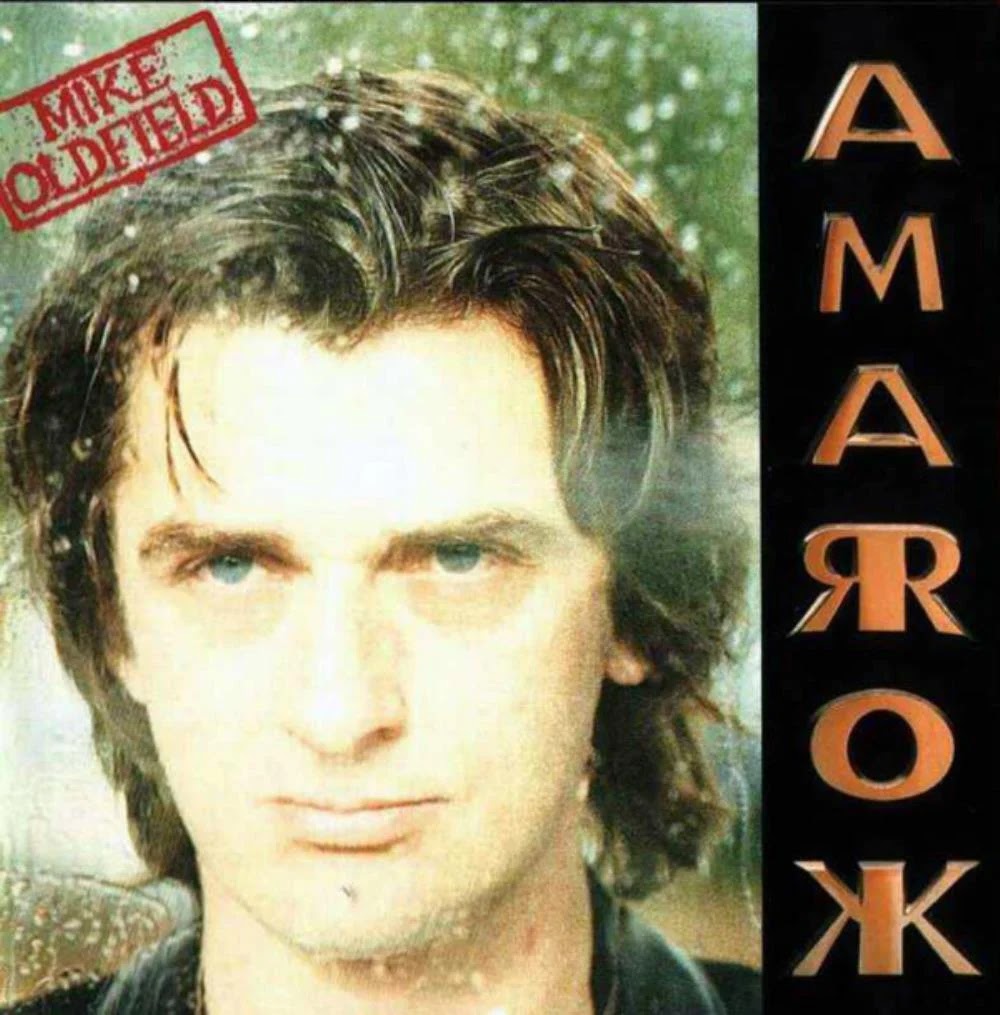
Amarok is the thirteenth studio album by English multi-instrumentalist and songwriter Mike Oldfield, released in May 1990 by Virgin Records. Oldfield originally conceived it as an "angry protest album", showcasing his musical technique.[2] It is presented as a single sixty-minute track of continuous, uninterrupted but constantly changing music.
In July 1989 Oldfield released Earth Moving, his twelfth album for Virgin Records.
By this time, his relationship with the label had become increasingly
fraught as a result of disagreements over his contract, royalties, and
the lack of effort in promoting his albums. Earth Moving was an
album whereby he "listened to Virgin totally" in regards to its musical
direction, which became a success in continental Europe, but received a
disappointing reaction in England, for which Oldfield received "some
flak" from Virgin over the matter.[3]
Oldfield was now required to deliver two more albums as part of his
Virgin contract and in the summer of 1989, he started on one with the
aim of pleasing his fans while annoying Virgin executives. Oldfield
deemed Amarok his "personal revenge" for Virgin's lack of support.[4]
The idea for Amarok originated in August 1989, when
Oldfield recorded a session for broadcast on BBC Radio 1 that included a
7-minute excerpt of his debut album Tubular Bells (1973) performed by himself. Oldfield had fun in the process, which inspired him to make Amarok in such a way.[3]
When Oldfield started to write and arrange "Amarok", he ignored the
pressures of delivering commercial material for Virgin and instead "let
it all come out without any interference [...] I felt I was getting
ideas from somewhere inside me, and six months later I had a whole
album."[3]
He decided upon an album that contained one 60-minute piece which,
unlike his previous long tracks, was not split into sections. Such a
format would create difficulty for Virgin to market or promote with
radio airplay. He avoided letting a theme become something that Virgin
might have identified suitable for a single, and developed ideas by
"imagining sound, not picture".[3]
Oldfield's contract with Virgin expired on 1 January 1991.[5]