12 Feb 2013: "Breathing Space", the debut solo album by UK keyboardist Iain Jennings and "Weather Systems", tAnathema.

Breathing Space is the debut solo album by UK keyboardist Iain Jennings. Although this album was originally released as Iain Jennings's album, it has become known as Breathing Space's (the band that was created for the following tour) first album because of the subsequent tours and the follow-up album Coming Up for Air in 2007.

Track listing

  1. "Forgive or Surrender" - 5:06
  2. "I've Been Thinking" - 5:06
  3. "Shades of Grey" - 5:10
  4. "No Promises" - 4:40
  5. "Man Made Circles" - 7:06
  6. "Wasted All the Time" - 6:03
  7. "Belief" (Sparnenn/Jennings) - 5:42
  8. "You Still Linger" - 8:36
  9. "Escape" - 8:11
(All songs written by Iain Jennings except where notes)

Credits (directly from Sleeve Notes)

With:
  • Olivia Sparnenn - lead/backing vocals (Tracks 1,2,3,4,6,7 and 8)
  • Liam Davison - lead/rhythm/acoustic guitars, bass guitars
  • Bryan Josh - guitar solos (4 and 8)
  • Andrew Jennings - drums, percussion
Weather Systems is the ninth studio album of atmospheric rock band Anathema. It was released on 16 April 2012 in Europe via Kscope and April 24, 2012 in the US via The End Records. The band describes the album as "not background music for parties. The music is written to deeply move the listener".[2] The album was recorded in Liverpool, North Wales and Oslo, each place significant to Anathema's past, present and future. The record was produced by band members Vincent Cavanagh and Daniel Cavanagh, as well as Christer-André Cederberg.
Recorded and released between the departure of Les Smith and the full-time joigning of live member Daniel Cardoso, it is the first album of the band to not feature a full-time keyboardist since Judgement in 1999.

18 December 2012: A Jethro Tull Christmas


The Jethro Tull Christmas Album is the 21st studio album released by Jethro Tull, on 30 September 2003 (see 2003 in music). The songs are a mix of new material, re-recordings of Tull's own suitably themed material and arrangements of traditional Christmas music. In 2009, the live album Christmas at St Bride's 2008 was included with the original album on CD.
Ian Anderson about the song Birthday Card at Christmas: "My daughter Gael, like millions of other unfortunates, celebrates her birthday within a gnat’s whisker of Christmas. Overshadowed by the Great Occasion, such birthdays can be flat, perfunctory and fleetingly token in their uneventful passing. The daunting party and festive celebration of the Christian calendar overshadows too, some might argue, the humble birthday of one Mr. J. Christ. Funny old 25ths, Decembers…"

11 Dec 2012: Matt Stevens (Spencer Park Music Sampler)& Organic Space


UK prog guitar virtuoso Matt Stevens offers a grab bag of his solo recordings, Yonks (his collaboration with producer and electronica artist, Lextrical), and his band The Fierce And The Dead on the Spencer Park Music Sampler 2012. Matt is on a roll lately and his talent is being recognised as an important artist by the UK prog press.
Some of the stuff hasn't been released before, making it worthwhile for his longtime followers.
Matt Stevens: Spencer Park Music Sampler 2012 Download it for free from his website.
Tracks:
  1. The Fierce And The Dead - On VHS 04:52
  2. Matt Stevens - Sand (Part 2) Extended Mix 05:29
  3. Yonks - Yonks 8 05:27
  4. Matt Stevens - Frost 02:47
  5. Matt Stevens - Dolls House (Dandelion Radio Sessions Version) 14:01
  6. The Fierce And The Dead - 666...6 04:42
  7. Matt Stevens - Eleven 02:35
  8. The Fierce And The Dead - Andy Fox 06:09
Influences:


04 December 2012: Octane Twisted - Porcupine Tree

Recorded in a concert at the Riviera Theater, Chicago, on April 30, 2010. The 2 disc set consists of The Incident played in its entirety, and songs recorded at the band's 2010 show at the Royal Albert Hall.


27 November 2012: Emerson, Lake, and Palmer 40th Anniversary Releases

New remixes by (who else) Mr. Steven Wilson.

Emerson, Lake & Palmer, also known as ELP, are a sporadically active English progressive rock supergroup.[1] They found success in the 1970s and have sold over forty million albums[2] and headlined large stadium concerts. The band consists of Keith Emerson (keyboards), Greg Lake (bass guitar, vocals, guitar) and Carl Palmer (drums, percussion). They are one of the most popular[3] and commercially successful progressive rock bands.
The ELP sound is dominated by the Hammond organ and Moog synthesiser of the flamboyant Emerson. The band's compositions are heavily influenced by classical music in addition to jazz and – at least in their early years – hard rock. Many of their pieces are arrangements of, or contain quotations from, classical music, and they can be said to fit into the sub-genre of symphonic rock. However, Lake ensured that their albums contained a regular stream of simple, accessible acoustic ballads, many of which received heavy radio airplay.[4] Lake, besides providing vocals, bass guitar, electric guitar and lyrics, also produced the band's first five albums.

Their debut album was simply titled Emerson, Lake & Palmer, and was released in late 1970. It was mostly a collection of solo pieces. Keith Emerson contributed a series of treatments of classical pieces (such as Bach's French Suite No. 1 in D minor, BWV 812 and Bartok's 'Allegro Barbaro'), Carl Palmer provided a drum solo (called "Tank") and Greg Lake provided two ballads, beginning with the folky, extended work "Take a Pebble". It was the ballad, "Lucky Man", which was a song Lake wrote when he had his first guitar at the age of 12,[18] that brought the band to prominence. It received heavy radio play in the UK and Europe, and also became a surprise hit in America.[19] The commercial success of "Lucky Man", combined with a strong performance at the Isle of Wight festival (released on CD in 1997 as Live at the Isle of Wight Festival 1970), brought ELP rapidly to prominence.
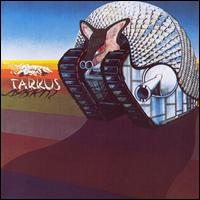
Tarkus, released in 1971, was their first successful concept album, described as a story about "reverse evolution". Combining a side-long song with an assortment of hard rock songs, an instrumental and even some comic songs, it was quickly cited as landmark work in progressive rock. The epic "Tarkus", recorded in just 4 days, is a seven-part rock suite which incorporates a number of complex time signatures. The breadth and complexity of the music combined with the series of William Neal paintings incorporated into the sleeve art helped to cement ELP's reputation as being on the forefront of progressive rock music.


20 November 2012: Thick as a Brick I and II


Thick as a Brick

From Wikipedia, the free encyclopedia
Jump to: navigation, search
Thick as a Brick
Studio album by Jethro Tull
Released 10 March 1972
Recorded December 1971 at Morgan Studios, London
Genre Progressive rock, art rock, hard rock[1], folk rock
Length 43:46
Label Chrysalis , Reprise
Producer Ian Anderson
Jethro Tull chronology
Aqualung
(1971)
Thick as a Brick
(1972)
Living in the Past
(1972)

Alternative cover

The cover of the 1997 25th anniversary re-release. Note the vertically elongated front page image and the completely different leftmost panel.
Professional ratings
Review scores
Source Rating
Allmusic 4.5/5 stars [2]
Robert Christgau C− [3]
Rolling Stone 5/5 stars [4]
George Starostin 13/15 stars [5]
Thick as a Brick is the fifth studio album by the English progressive rock band Jethro Tull. Released in 1972, the album includes only one song, the title track, which spans the entire album. Thick as a Brick was deliberately crafted in the style (and as a "bombastic" and "over the top" parody[6]) of a concept album. The original packaging, designed like a newspaper, claims the album to be a musical adaptation of an epic poem by a (fictional) 8-year-old boy, though the lyrics were actually written by the band's frontman, Ian Anderson.

Contents

Album information

Thick as a Brick was Jethro Tull's first deep progressive rock offering, coming four years after the release of their first album. The epic album is notable for its many musical themes, time signature changes and tempo shifts--all of which were features of the progressive rock scene which was emerging at the time. In addition, the instrumentation includes harpsichord, xylophone, timpani, violin, lute, trumpet, saxophone, and a string section--all uncommon in blues-based rock.
Band leader Ian Anderson was surprised by the critical reaction to the previous album, Aqualung, as a "concept album", a label he firmly rejects to this day. In an interview on In the Studio with Redbeard (which spotlighted Thick as a Brick), Anderson's response to the critics was: "If the critics want a concept album we'll give the mother of all concept albums and we'll make it so bombastic and so over the top."[6] Ian Anderson has been quoted as stating that Thick as a Brick was written "because everyone was saying we were a progressive rock band, so we decided to live up to the reputation and write a progressive album, but done as a parody of the genre." With Thick as a Brick, the band created an album deliberately integrated around one concept: a poem by an intelligent English boy (named Gerald) about the trials of growing up. Beyond this, the album was a send-up of all pretentious "concept albums". (The simile "Thick as a brick", in English, is an expression signifying someone who is "stupid; slow to learn or understand".[7])
Anderson also stated in that interview that "the album was a spoof to the albums of Yes and Emerson, Lake & Palmer, much like what the movie Airplane! had been to Airport." The formula was successful, and the album reached number one on the charts in the United States.
On April 3, 2012, Ian Anderson released a long-delayed sequel, Thick As a Brick 2, on the EMI label, continuing the story of Gerald Bostock. The original in a deluxe CD/DVD edition with a large book will be reissued by EMI on November 6, 2012.

Live performances

Beginning in March 1972, the band performed most of the album (excluding some of the edits on side 2) on tour for nearly a year. The performances grew in length to about 90 minutes, as the original piece was expanded with additional instrumental interludes and the instrumentals "God Rest Ye Merry Gentlemen" and "Bouree." At the conclusion of what was side one of the LP, a 5-minute "news and weather" comedy routine was inserted, giving the band (and audience) a break from the non-stop music. At concerts in Germany and Italy, the routine was presented in the native language. The performance of side two of the LP was expanded with the addition of a long drum solo. The remainder of the set list (with occasional changes throughout the tour) consisted of "Cross-Eyed Mary", "A New Day Yesterday", "Aqualung", "Wind-Up", "Martin's Guitar Solo", "Locomotive Breath" and "Wind-Up (Reprise)." "Wind-up" included an unreleased piece referred to by bootleg fans as "The Hard Headed English General". Later live performances of "Thick as a Brick" were a shortened version of the first side, as heard on the live album Bursting Out (1978).
Ian Anderson performed the entire album live on tour in 2012, the first complete performances since the 1972 tour.[8]

Cover art and packaging


The original LP cover, which opens up as a 12-page newspaper.
The original LP cover was designed as a spoof of a 12-by-16 inch (305 by 406 mm) multiple-paged small-town English newspaper, entitled The St. Cleve Chronicle and Linwell Advertiser, with articles, competitions, adverts, etc., lampooning the parochial and amateurish local journalism that still exists in many places today, as well as certain classical album covers. Jethro Tull's official website states about the mock-newspaper: "There are a lot of inside puns, cleverly hidden continuing jokes (such as the experimental non-rabbit), a surprisingly frank review of the album itself [written by Anderson under a pseudonym], and even a little naughty connect-the-dots children's activity."[9] The "newspaper", dated 7 January 1972, also includes the entire lyrics to "Thick as a Brick" (printed on page 7), which is presented as a poem written by an 8-year-old literary prodigy, Gerald "Little Milton" Bostock, whose disqualification from a poetry contest is the focus of the front page story. This article claims that although Bostock initially won the contest with "Thick as a Brick," the judges' decision was repealed after a multitude of protests and threats concerning the offensive nature of the poem, furthered by allegations of the boy's psychological instability. Throughout the newspaper's many articles are subtly scattered various references to the lyrics, to Gerald Bostock, to Jethro Tull, and to other peculiar parts of the newspaper itself. The satirical newspaper was heavily abridged for conventional CD booklets, but the 25th Anniversary Special Edition CD cover is much closer to the original, and the 40th anniversary boxed version contains a nearly-complete replica of the original newspaper, missing only an article spoofing former U.S. Tull distributor Reprise Records.

Track listing

All lyrics written by "Gerald Bostock" (Ian Anderson), all music composed by Ian Anderson.
Side one
No. Title Length
1. "Thick as a Brick, Part I"   22:40
Side two
No. Title Length
2. "Thick as a Brick, Part II"   21:06
25th Anniversary Edition bonus tracks
No. Title Length
3. "Thick as a Brick" (1978 live version at Madison Square Garden) 10:50
4. "Interview with Jethro Tull" (Ian Anderson, Martin Barre and Jeffrey Hammond-Hammond) 16:30
40th Anniversary Edition bonus track
No. Title Length
3. "1972 Radio Ad"   0:59

Differences among various CD releases

By 2012 the album received four major releases on CD: the first release (1985),[10] the MFSL-release (1989),[10] the 25th Anniversary Edition (1997), and the 40th Anniversary Edition (2012). Whereas the first release and the MFSL-release run with identical speed, the 25th Anniversary edition runs 0.5% slower[citation needed]. The 1997 edition also has increased loudness (see Loudness war) and does not feature Ian Anderson whispering "Yeah" after the coda of Part II.
The 40th Anniversary Edition was released in November 2012, and includes a CD, a DVD, and a book. The CD contains a new mix of the album. The DVD contains a 5.1 surround sound mix (in DTS and Dolby Digital), the new stereo mix in high resolution, and the original stereo mix in high resolution. The album was also rereleased on vinyl at the same time.[11] This edition lists part one at 22:45 and part two at 21:07.
The website for the 40th anniversary edition lists these digital parts:
  1. Really Don't Mind/See There a Son Is Born
  2. The Poet and the Painter
  3. What Do You Do When the Old Man's Gone?/From the Upper Class
  4. You Curl Your Toes in Fun/Childhood Heroes/Stabs Instrumental
  5. See There a Man Is Born/Clear White Circles
  6. Legends and Believe in the Day
  7. Tales of Your Life
  8. Childhood Heroes Reprise.[12]

In pop culture

The song itself has been played on many classic rock radio stations across the globe. Most opt to play the single edit, clocking in at approximately three minutes. However, some prefer the longer 7-minute version which contains the Side One main theme, "Come On Ye Childhood Heroes", and the closing theme from Side Two.
In 1983, Chrisye released a cassette called Resesi (Recession) which had a cover inspired by the album. The album was rereleased on CD in 2004.
At the end of the The Simpsons episode "Girls Just Want to Have Sums", Martin Prince sings "Thick as a Brick" until Lisa Simpson hits him with a folding chair to shut him up. The actual song plays over the closing credits.
Car maker Hyundai used the song in one of their commercials in the early 2000s.

The 2012 follow-up: Thick as a Brick 2: Whatever Happened to Gerald Bostock?

On 1 February 2012 Ian Anderson announced via the official Jethro Tull website that there was to be a follow-up album, TAAB2: Whatever Happened To Gerald Bostock?. According to the Jethro Tull website, the sequel is "a full length Progressive Rock 'concept' album worthy of its predecessor. Boy to man and beyond, it looks at what might have befallen the child poet Gerald Bostock in later life. Or, perhaps, any of us."
The album was released on 2 April 2012. It describes five different scenarios of Gerald Bostock's life, where he potentially becomes a greedy investment banker, a homeless homosexual man, a soldier in the Afghan War, a sanctimonious evangelist preacher, and a most ordinary man who runs a corner store and is married and childless. The original Thick as a Brick consists of only two long tracks comprising a single song, while TAAB2: Whatever Happened To Gerald Bostock? lists 17 separate songs merged into 13 distinct tracks (some labelled as medleys), although also all flowing together much like a single song. To follow the style of the mock newspaper on the original Thick as a Brick, a mock online newspaper was set up, simply titled StCleve.

Chart positions of the original 1972 album

Year Chart Position
1972 Billboard 200 1
Australian Kent Music Report Albums Chart

Artists

References

External links


13 November 2012: An Evening of Steven Wilson


Get All You Deserve recorded live in Mexico City, April 2012

29 November 2011: DiN20 - Sampler iNDEX02 - Ian Body et al


11 October 2011: Symphonic Prog from Canarios & LINDH PÄR/BJÖRN JOHANSSON

Lindh Pär and Björn Johansson biography
      Well, it's not easy to make a bio of Par Lindh & Bjorn Johansson because we're not talking about a band but about a project to release one (first) Tolkien related album, Bilbo and later "Dreamsongs from the Middle Earth".  This two friends and excellent musicians had worked together for a long time, Bjorn even played guitars in the first PAR LINDH PROJECT" album "Gothic Impressions, being an important part of it.    It's unnecessary to talk about Par Lindh and his long career with bands as ANTENNA BAROQUE, the Symphonic Trio VINCEBUS EREPTUM, his solo career as Church Organ virtuoso, Keyboardist, Classical Pianist, drummer and President of the Swedish Art Rock Society plus responsible of PAR LINDH PROJECT, so lets talk a bit about the incredible guitar player called Bjorn Johansson, who is not as well known as the Organ wizard but is also transcendental for Scandinavian Symphonic.    Bjorn is mainly a guitar player but as Mike Oldfield he's more than proficient in almost every one it's enough to mention that in his recordings with Par Lindh he plays classical guitars, 12 string guitars, 6 string steel guitars, electric guitars, slide guitars, sitar guitar, zither, Jews harp, mandolins, bouzoki, bassoon, tin whistle, low whistle, Akai S2000 sampler, Giga studio sampler, Access Virus virtual analogue synthesizer, jingle bells, vibraslap & cabasa Bass.   After releasing Gothic Impressions, Pär Lindh approached Bjorn because of his great interest in releasing a Tolkien based album called "Bilbo" (1996), in the vein of Bo Hansson's Lord of the Rings but with a clear Medieval and Baroque influence so beloved by both musicians.    In this first project they counted with Magdalena Hagsberg and Anna Scmidtdz in the flutes.   In 2004 they rejoin again to release their second joint project called Dreamsomngs from Middle Earth, again with members of Par Lindh Project as Magdalena Hagsberg and Lovisa Stenberg plus Roine Stolt from THE FLOWER KINGS who plays bass in the track "Dream Three""    This album has a more Classic Symphonic approach, giving a different perspective to Tolkien's narrations.  (from ProgArchives.com)
Los Canarios biography  (from Progarchives.com)
LOS CANARIOS was a Spanish band that started playing back in the late 60's. At the beginning, they played Soul and R&B influenced music, singing mostly in English. Recorded in the Seventies, "Circlos" shows an adaptation of VIVALDI's "Four Seasons" with a rock and Hispanic flavour. This is a concept album with an interesting story line that goes from the creation of the Earth to the Apocalypse in 2700 A.C.

The music reminds of this era, with a predominant Hammond organ, a blend of rock and classical music in the style of THE NICE and other EKSEPTION. This album is a heavy and dynamic work in its own right with plenty of synth and organ work as well as guitar. Vocals (in English) are heard throughout but I'd say the album is dominated by instrumental sections. "Ciclos" is a classic of the Spanish progressive scene. But otherwise I have to agree with other prog fans that this is a classic.

DISCOGRAPHY:
1968 - Lo Mejor Del Clan
1970 - Libérate
1972 - Canarios Vivos
1974 - Ciclos 

04 October 2011: Steven Wilson "Grace For Drowning"

From Steven Wilson on his second solo release (a 2cd set):
"'Insurgentes' was an important step for me into something new. This record takes that as a starting point, but it’s more experimental and more eclectic. For me the golden period for music was the late sixties and early seventies, when the album became the primary means of artistic expression, when musicians liberated themselves from the 3 minute pop song format, and started to draw on jazz and classical music especially, combining it with the spirit of psychedelia to create “journeys in sound” I guess you could call them. So without being retro, my album is a kind of homage to that spirit. There’s everything from [Ennio] Morricone-esque film themes to choral music to piano ballads to a 23 minute progressive jazz –inspired piece. I've actually used a few jazz musicians this time, which is something I picked up from my work remixing the King Crimson records"[6]
All songs written and composed by Steven Wilson.
Disc 1: Deform to Form a Star
No. Title Length
1. "Grace for Drowning"   2:06
2. "Sectarian"   7:41
3. "Deform to Form a Star"   7:51
4. "No Part of Me"   5:45
5. "Postcard"   4:29
6. "Raider Prelude"   2:23
7. "Remainder the Black Dog"   9:27
Disc 2: Like Dust I Have Cleared From My Eye
No. Title Length
1. "Belle de Jour"   2:59
2. "Index"   4:49
3. "Track One"   4:16
4. "Raider II"   23:21
5. "Like Dust I Have Cleared From My Eye"   8:01

27 Sept 2011: FreeForm Progressive Goes Elk Hunting on Afognak Island

Tonight's host may or may not be playing progressive music - see you next Tuesday!

20 Sept 2011: Children of the Bong & King Crimson

Children of the Bong was an electronic band formed in the early 1990s by Rob Henry and Daniel Goganian. They signed to Planet Dog Records in 1994 and released one album, Sirius Sounds, as well as a couple of tracks on Planet Dog compilations. The band recorded a Peel Session for DJ John Peel on BBC Radio 1 on 26 April 1994 [1]
The group split up shortly after the release of the album. Rob Henry went on to form a band called Euphonic and now plays in a band called Neech. Daniel Goganian went on to study at the National Film and Television School and now works in the film and television industry for Savalas Audio Post Production in Glasgow, Scotland. He also plays samba percussion for the Paraiso School of Samba in London.

Larks' Tongues in Aspic is the fifth studio album by the English progressive rock group King Crimson, originally released in 1973. This album is the debut of King Crimson's third incarnation - arguably their most forward-thinking thinking version yet, featuring original member and guitarist Robert Fripp and new members John Wetton (vocals, bass guitar), David Cross (violin, Mellotron), Jamie Muir (percussion), and Bill Bruford (drums), as well as lyricist Richard Palmer-James. Bruford had just left his previous band, Yes before they embarked on their "Close To The Edge" tour. Bruford felt that he had done all he could with Yes at this point and thought the more jazz oriented King Crimson would be a more expansive outlet. The album sees the band incorporate into its sound violin and also various exotic percussion instruments, including sheet metal and mbiras, all courtesy of the newly arrived Muir.
The album opens with a long experimental instrumental piece titled "Larks' Tongues in Aspic, Part One." After that there are three vocal pieces, "Book of Saturday", "Exiles" and "Easy Money." These are followed by two more instrumentals, "The Talking Drum" and "Larks' Tongues in Aspic, Part Two." The instrumental pieces on this album have strong jazz fusion influences, and portions have an almost heavy metal feel.
The album spawned the concert staple "Exiles", whose Mellotron introduction had been adapted from an instrumental piece called "Mantra" the band's original line up performed throughout 1969. At that time, as well as in late 1972, the melody was played by Fripp on guitar.
It is the only studio album with this 5-man line up. Muir left the group while on tour promoting this album in 1973. Attrition took this incarnation of King Crimson through the next several albums until Fripp's "retirement" in 1975.
In the Q & Mojo Classic Special Edition Pink Floyd & The Story of Prog Rock, the album came #22 in its list of "40 Cosmic Rock Albums". (from Wikipedia)