Showing posts with label nick mason. Show all posts

01 September 2026: Pink Floyd "Atom Heart Mother"; Dane Law & Chants "Bonded Pairs" Quiet Details 53

Be sure to follow KMXT FreeForm Radio on Facebook and Bandcamp and Spotify.  

You can now listen to the livestream of the show through the KMXT app; it's available through the Mac App Store or Google Play. The stream is also available at www.kmxt.org

Please support FreeForm Radio and KMXT by going to www.KMXT.org and pledging your support.

The music you hear on tonight's show is available on the artists' Bandcamp pages and websites. (links below) 

                    We urge you to support the musicians you hear on FreeForm Radio


Atom Heart Mother is the fifth studio album by the English rock band Pink Floyd. It was released by Harvest on 2 October 1970 in the United Kingdom, and on 10 October 1970 in the United States.[3] It was recorded at EMI Studios (now Abbey Road Studios) in London, and was the band's first album to reach number 1 in the UK, while it reached number 55 in the US, eventually going gold there.[4]

The cover was designed by Hipgnosis, and was the band's first not to feature their name, or have photographs of them on any part of it. This was a trend that would continue on subsequent covers throughout the 1970s. The cover shows a Holstein cow on a meadow landscape.

Although it was commercially successful on release, the band  particularly Roger Waters and David Gilmour  have expressed negative opinions of the album. A remastered CD was released in 1994 in the UK and the US, and again in 2011. Ron Geesin, who had influenced and collaborated with Waters, co-composed the title track.
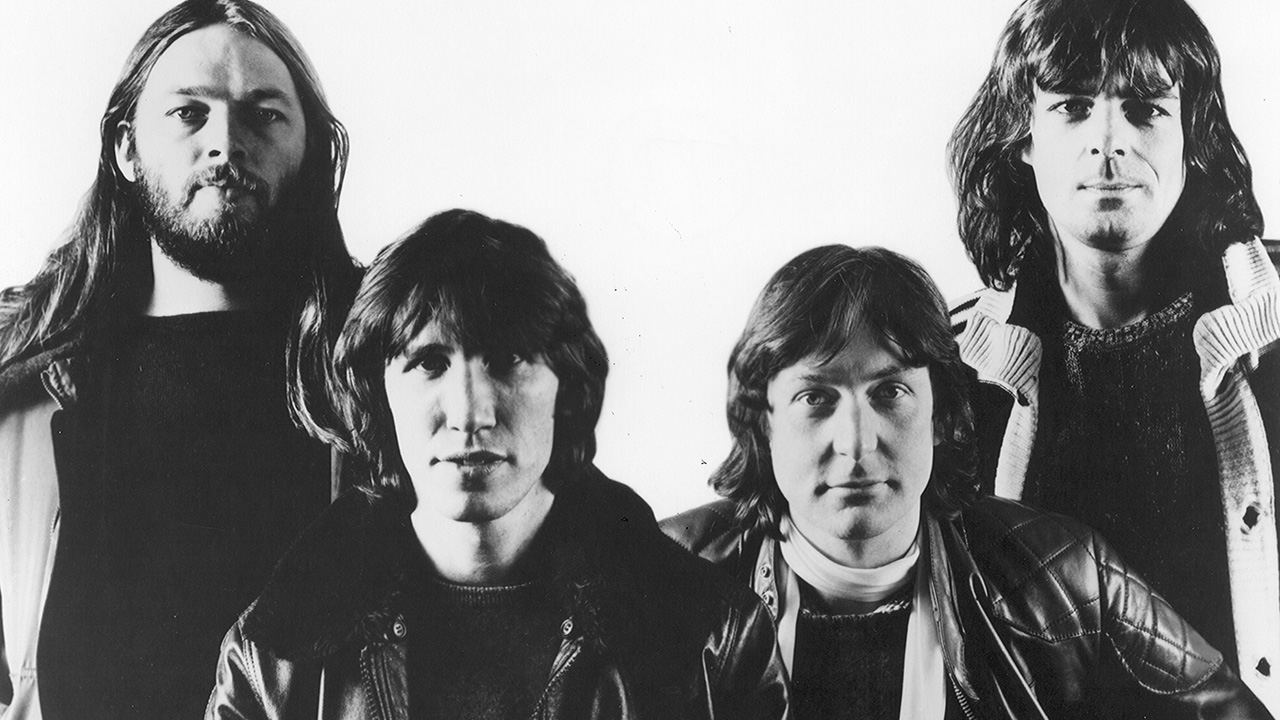
“We went through a few phrases… they went off to play in America and left me to get on with it, stripped to my underpants”: Atom Heart Mother’s fusion of ordinary and extraordinary sounds gave Pink Floyd their first No.1 album

Pink Floyd 1970
(Image credit: Getty Images)

From the hell of an Italian trip to the heaven of Hyde Park, the year leading up to the release of Atom Heart Mother was a life-changing time for Pink Floyd. In 2016 Prog looked back at the events that helped shape the band’s first No.1 album.


“Ah, Friesians.” It was summer 1970 and LG Wood, managing director of EMI’s Record Division, was peering at the cover of Pink Floyd’s Atom Heart Mother. It was EMI policy for Wood to sign off on all EMI album sleeves, but here was a cover missing a title and the group’s name. Instead, there was just a cow in a field. Presuming there were words somewhere, Wood turned the sleeve over, only to find more cows. According to one eyewitness, “Ah, Friesians” was all the baffled MD could muster.

Three months later, Atom Heart Mother became Floyd’s first No.1 album. EMI’s powers that be already knew that strange-sounding hairy rock groups sold lots of records. Now, it seemed, they could do so without including their name or the album title on the cover. Just a cow in a field.

The band’s gargantuan seven-volume box set, The Early Years 1965-1972, dedicates an entire volume, Devi/Ation, to Atom Heart Mother and the Zabriskie Point soundtrack that inspired its title track. Here you’ll find the earliest known recording of the AHM suite, plus filmed performances from Hyde Park and St Tropez, and much more besides.

But Atom Heart Mother is probably better known for the cow than the music. Revisiting the album now is like entering a parallel universe inhabited by epic orchestral suites and songs created from the sounds of boiling kettles and frying bacon. Floyd would make better albums, but it remains the apotheosis of their experimental era – or as guitarist David Gilmour later described it, “Our weird shit.”


For the next release in the quiet details series, it’s my great pleasure to share with you a wonderful collaboration from the perfectly-matched pair of Adam Parkinson and Jordan Cohen, otherwise know as Dane Law & Chants, with Bonded Pairs

 Public announcement 26th August; full release 2nd September 2026.

Both have extensive bodies of solo work: Adam using deep programming skills with the likes of Max/MSP alongside deft guitar and production expertise to release on the likes of Opal Tapes, Blue Tapes, Quantum Natives and more; and Jordan, a vastly talented drummer and producer, on Hush Hush, Astral Plane Recordings and others.

Their previous collaboration, on The Trilogy Tapes, was a masterclass in human performance excellence and digital sonic manipulation - and Bonded Pairs builds on that in stunning fashion.

Hypnotic percussive structures and ever-evolving textures are the core of the album - realised by a range of acoustic instruments, and custom-built software processing.

The creative imagination on display here is truly something to behold - their tactile instrumental skills provide incredible source material, and their mastery of computer-based transformations allows them to shape these complex collages. Defying classification, this is an album of huge scope and inventiveness.

As they say:

Materials: guitar, drums, cello, saxophone, trumpet, balafon, and voice.
Transmuted digitally to access the ineffable.

Guitar and drums take centre stage, melodic and metrical - sampled, rearranged, merged into shifting rhythmical patterns that move in and out of focus. These are complimented by the textural beauty of the other instruments, giving harmonic depth to the pieces, and the arrangements’ true musical maturity.

Intricate polyrhythms, emotive diversity, ineffable soundscapes - the album as a whole is unique quiet details interpretation, and it’s an honour to share it with you.

Huge thanks to Dane Law & Chants, a fantastic addition to the series.

Thanks also to:
Greg Riss - additional drumming on ‘Paths to Leyton’ and ‘Drum Drone (Four Mallets)’
Contains samples of performances by:
Bossada - saxophone
Brian Grimm - cello
Charlie Palm - trumpet

The artwork was made as always influenced by the music and idea behind the album - originating from a photo from the pair which was then captured with analogue photography and processed here at quiet details studios.

As usual, the album is presented on the physical edition, a custom six-panel digipack with a separate fine art print too.

The CD also has a special long-form continuous mix of the album, unique and representing the music in its purest form.

Credits:
Music by Dane Law & Chants
Mastered by Alex at quiet details studios
Artwork by quiet details in collaboration with Dane Law & Chants
Design by quiet details
© quiet details 2026 all rights reserved


19 May 2025: Gordon Giltrap "Live at Oxford 1979"; Richard Wright "Wet Dream"

Be sure to follow KMXT FreeForm Radio on Facebook and Bandcamp and Spotify.  

You can now listen to the livestream of the show through the KMXT app; it's available through the Mac App Store or Google Play. The stream is also available at www.kmxt.org

Please support FreeForm Radio and KMXT by going to www.KMXT.org and pledging your support.

The music you hear on tonight's show is available on the artists' Bandcamp pages and websites. (links below) 

                    We urge you to support the musicians you hear on FreeForm Radio 

I am also hosting Rural Electric, so tune in for some great country music from 7-9 before FreeForm! 


This is one of my favorite live albums of all time; Gordon Giltrap had a brief "progressive rock" phase and this album is an excellent chronicle of my favorite GG era.

Review by SouthSideoftheSky
SPECIAL COLLABORATOR Symphonic Team

Fast approaching

This excellent live album can be summed up in a single sentence: Some of Gordon Giltrap's best and most memorable tunes from his three best and most progressive albums, performed with more energy and with more of an edge compared to the studio versions with a great band backing him up. When this live concert was recorded in the late 70's, Giltrap was at the peak of his progressive period and had just released three good studio albums in Visionary, Perilous Journey, and Fear Of The Dark. So there was never a better time for him to record a live album and the result is a very good introduction to Gordon Giltrap.

Apart from Giltrap himself, the band consists of no less than two keyboard players in Rod Edwards and Eddie Spence, John Gustafson (who was also part of the Ian Gillan Band) on bass, and Ian Mosley (who also played with Steve Hackett and later became a member of Marillion) on drums. While most of the show is instrumental, there are a few numbers with Shirley Roden on vocals. The parts on which she sings lead remind me of the band Renaissance. The similarities with that band on these parts are particularly strong due to the combination of the music's being driven by acoustic guitar and piano, backed up by a rhythm section of electric bass and drums. Add to that a female vocalist in a somewhat similar style to Annie Haslam, singing songs with folky as well as Symphonic aspects.

But there are also many electronic keyboards used and Giltrap alternates here between acoustic and electric guitars to great effect. His acoustic guitar playing is the most impressive and he showcases very well his trademark acoustic style (that influenced among others Ritchie Blackmore's acoustic playing). Giltrap's speed and accuracy is incredible, and he plays even the most complex and fast parts with such ease and makes not the slightest mistake. But unlike some other technically skilled guitar players, he never lets technicality overshadow the often gorgeous melodies. His electric guitar playing is less distinctive, but is an essential ingredient in the overall sound. Also, though Giltrap is the star, he does not steal the show and allows the whole band to shine.

Live At Oxford is a fine addition to many a Prog fan's collection 

Review by kenethlevine
SPECIAL COLLABORATOR Prog-Folk Team

A live performance for essentially a solo guitarist always raises the question of faithful sound reproduction. For instance, GORDON GILTRAP plays both electric and acoustic guitar very well. Does he go with an additional guitarist to complement or at least not cramp his style? What of other instrumentation like sax which he occasionally hires? Should vocals be introduced for variety? On "Live at Oxford" GILTRAP makes several brilliant choices - hiring a competent backing rock band, continuing to play all guitars himself, engaging a female vocalist, and utilizing keyboards and vocals to fill some of the additional guitar and brass sounds. How he implements these decisions results in a show and a resulting album that plays to his strengths while rendering his shortcomings moot.

In some sense this virtuoso's work is best suited to the live setting, since his primary talent is in playing and, to some extent, arranging, as opposed to composition. Luckily his skill is exposed in a measured fashion throughout. The main source of material is "Fear of the Dark", the most recent album at the time of the concert, and it would be hard to imagine that those tracks represented here are not more fully realized than the studio versions. This is especially the case for the epic "Visitation" and the suspenseful "Fear of the Dark", both of which benefit from the sultry expressive vocals of SHIRLEY RODEN. Still, the best example of this adaptive spirit and of Roden's power is in "The Deserter"; originally an instrumental on "Perilous Journey", it is re-invented as a spacey lyrical piece with Roden's vocals replacing sax and some pointed guitar leads. I had never heard of Roden so has to look her up, and found that her limited credits include several prog artists including MICHAEL MOORCOCK, MIKE OLDFIELD and DAVID GILMOUR.

As is standard for Giltrap, none of the material or the performances are weak but here the energy of the live setting and the commitment to the team concept contribute equally to what could be the most suitable introduction to Gitrap for prog fans. 


Pink Floyd founder member and keyboardist Richard Wright’s debut solo album, Wet Dream, is to be reissued in July.

The album has been remixed by Steven Wilson in Dolby Atmos, 5.1 and stereo for this release. The original mix does not feature on any of the three physical formats and all the new mixes include some extra passages of music that were edited out of the original.

Originally released between Pink Floyd’s Animals (1977) and The Wall (1979), Wet Dream was self-produced and Wright wrote all the songs (except ‘Against the Odds’, which was co-written with his then-wife, Juliette). Remarkably, the album flew under the radar was at best under appreciated, if not almost unnoticed at the time.

Richard Wright’s “Wet Dream” (1978): A Remix Revelation by Steven Wilson

The Original “Wet Dream”
Released in 1978, Richard Wright’s “Wet Dream” is an album I’ve cherished, even owning a vinyl copy tucked away probably in my garage. It’s a beautiful blend of instrumentals and vocals, showcasing Wright’s jazz inclinations. While I’ve always had a soft spot for “Broken China” among Wright’s solo works, “Wet Dream” is undeniably pleasant, a testament to his musical prowess.

Steven Wilson’s 2023 Remix
Fast forward to 2023, and we have a remix by the renowned Steven Wilson. Now, we’ve all seen remastered versions of albums, but a remix is a different beast altogether. Wilson’s expertise in extracting nuances from old recordings and highlighting elements we might have missed is unparalleled. His ability to enhance without altering our cherished memories of the original tracks is nothing short of genius.

This remix is a revelation. From the very first play, tracks like “Mediterranean Sea,” “Against the Odds,” and “White Waves” felt rejuvenated. The clarity with which each instrument stands out, be it Snowy White’s guitar or Mel Collins’s saxophone, is astounding. It’s as if the musicians are right there in the room with you.

A Dive into the Details
There’s a slight discrepancy in the songwriting credits between the original and the remix. The original credits all songs to Richard Wright, except “Against the Odds” to Julie Wright. The remix, however, attributes the words for “Pink Song” to Juliet Wright. It’s a minor detail, but worth noting for the purists.

The remix also comes with a booklet featuring photographs taken by Richard Wright, capturing personal moments from his holidays. Fans of the original will appreciate the reproduced gatefold sleeve, a nostalgic nod to the 1978 release.

The Verdict
If you’re a Pink Floyd aficionado, this remix is a must-have. Even if you own the original, the Steven Wilson remix offers a fresh, immersive experience that’s hard to resist. It’s not just about the enhanced sound quality; it’s about the emotions it evokes. Listening to it in a dimly lit room, letting the music wash over you, is an experience I can’t recommend enough.

In conclusion, the 2023 remix of “Wet Dream” is a testament to both Richard Wright’s timeless artistry and Steven Wilson’s remixing prowess. It’s available now on Polarphone Records, and I urge you to give it a listen.

Phil Aston | Now Spinning Magazine


31 December 2024: A Pink Floyd New Year's Eve

Be sure to follow KMXT FreeForm Radio on Facebook and Bandcamp.  

Please support FreeForm Radio and KMXT by going to www.KMXT.org and pledging your support.

The music you hear is available on the artists' Bandcamp pages, websites, and Spotify

We urge you to support the musicians you hear on FreeForm Radio.

Beginnning at 9 pm Alaska Time, we'll be playing Pink Floyd nonstop until the two minute countdown to Midnight followed by Auld Lang Syne and one final Pink Floyd track.

Meddle is the sixth studio album by the English rock band Pink Floyd, released by Harvest Records on 5 November 1971 in the United Kingdom.[3] The album was produced between the band's touring commitments, from January to August 1971 at a series of locations around London, including EMI Studios (now Abbey Road Studios) and Morgan Studios.

With no material to work with and no clear idea of the album's direction, the band devised a series of novel experiments which eventually inspired the album's signature track "Echoes". Although the band's later albums would be unified by a central theme chosen by Roger Waters, and thematically consistent lyrics written entirely by Waters, Meddle was a group effort with Waters contributing primarily to the lyrics and the bass. It is considered a transitional album between the Syd Barrett-influenced group of the 1960s and the Waters-led era of the 1970s.[4] Fans often refer to this album, especially "Echoes", as the first instance of the group achieving their musical potential.

The Dark Side of the Moon is the eighth studio album by the English rock band Pink Floyd, released on 1 March 1973 by Harvest Records in the UK and Capitol Records in the US. Developed during live performances before recording began, it was conceived as a concept album that would focus on the pressures faced by the band during their arduous lifestyle, and also deal with the mental health problems of the former band member Syd Barrett, who had departed the group in 1968. New material was recorded in two sessions in 1972 and 1973 at EMI Studios (now Abbey Road Studios) in London.

The record builds on ideas explored in Pink Floyd's earlier recordings and performances, while omitting the extended instrumentals that characterised the band's earlier work. The group employed multitrack recordingtape loops, and analogue synthesisers, including experimentation with the EMS VCS 3 and a Synthi A. The engineer Alan Parsons was responsible for many aspects of the recording, and for the recruitment of the session singer Clare Torry, who appears on "The Great Gig in the Sky".

The Dark Side of the Moon explores themes such as conflict, greed, time, death, and mental illness. Snippets from interviews with the band's road crew and others are featured alongside philosophical quotations. The sleeve, which depicts a prismatic spectrum, was designed by Storm Thorgerson in response to the keyboardist Richard Wright's request for a "simple and bold" design which would represent the band's lighting and the album's themes. The album was promoted with two singles: "Money" and "Us and Them".

The Dark Side of the Moon has received widespread critical acclaim and is often featured in professional listings of the greatest albums of all time. It brought Pink Floyd international fame, wealth and plaudits to all four band members. A blockbuster release of the album era, it also propelled record sales throughout the music industry during the 1970s. The Dark Side of the Moon is certified 14× platinum in the United Kingdom, and topped the US Billboard Top LPs & Tape chart, where it has charted for 990 weeks. By 2013, The Dark Side of the Moon had sold over 45 million copies worldwide, making it the band's best-selling release, the best-selling album of the 1970s, and the fourth-best-selling album in history.[3] In 2012, the album was selected for preservation in the United States National Recording Registry by the Library of Congress as being "culturally, historically, or aesthetically significant". It was inducted into the Grammy Hall of Fame in 1999.[4]


Wish You Were Here is the ninth studio album by the English rock band Pink Floyd, released on 12 September 1975 through Harvest Records in the UK and Columbia Records in the US, their first for the label. Based on material Pink Floyd composed while performing in Europe, Wish You Were Here was recorded over numerous sessions throughout 1975 at EMI Studios in London.

The lyrics express alienation and criticism of the music business. The bulk of the album is taken up by "Shine On You Crazy Diamond", a nine-part tribute to the Pink Floyd co-founder Syd Barrett, who had left seven years earlier due to his deteriorating mental health. Barrett coincidentally visited during the recording. As with their previous release, The Dark Side of the Moon (1973), Pink Floyd employed studio effects and synthesisers. Guest singers included Roy Harper, who provided the lead vocals on "Have a Cigar", and Venetta Fields, who added backing vocals to "Shine On You Crazy Diamond". To promote the album, Pink Floyd released the double A-side single "Have a Cigar" / "Welcome to the Machine".

Wish You Were Here was certified gold in the UK and the US in its year of release and topped the charts in several European countries. By 2004, it had sold an estimated 13 million copies worldwide. It initially received mixed reviews; critics found its music uninspiring and inferior to Pink Floyd's previous work. It was later acclaimed as one of the greatest albums of all time, appearing on lists including Rolling Stone's list of the 500 greatest albums at which it was ranked at #264 in 2021. It was cited by the keyboardist, Richard Wright, and the guitarist, David Gilmour, as their favourite Pink Floyd album


Animals is the tenth studio album by the English rock band Pink Floyd, released on 21 January 1977,[2] by Harvest Records and Columbia Records. Pink Floyd produced it at their new studio, Britannia Row Studios, in London throughout 1976. The album continued the long-form compositions that made up such previous works as Meddle (1971) and Wish You Were Here (1975).

A lyrical departure from Pink Floyd's previous albums, Animals is a concept album that focuses on the sociopolitical conditions of mid-1970s Britain. Tension within the band during production culminated in the firing of the keyboardist, Richard Wright, two years after the album's release. The cover, conceived by the bassist and lead songwriter, Roger Waters, and designed by their long-time collaborator Storm Thorgerson, shows an inflatable pig floating between two chimneys of Battersea Power Station.

Pink Floyd released no singles from Animals but promoted it through the In the Flesh tour. Waters' agitation with audiences during this tour inspired their next album, The Wall (1979). Animals reached number 2 in the UK and number 3 in the US. It initially received mixed reviews, but gained more favourable reviews in later years, and is considered one of Pink Floyd's best works.

All album information taken from articles on Wikipedia.com


30 May 2023: Yes "Mirror to the Sky"; Pink Floyd "The Dark Side of the Moon" 50th Anniversary remaster; Michael Bonaventure "Retrospective"

Be sure to follow KMXT FreeForm Radio on Facebook and Bandcamp.  

Please support FreeForm Radio and KMXT by going to KMXT.org and pledging your support - 

You can still support the Spring Fund Drive: Donate Now!

The music you hear on tonight's show is available on the artists' Bandcamp pages and websites. (links below) 

We urge you to support the musicians you hear on FreeForm Radio.

I also host the Rural Electric (Mostly) Country Music show Tuesday from 7-9 pm ADT

This week featuring Aoife O'Donovan


Mirror to the Sky is the twenty-third studio album by English progressive rock band Yes, released on 19 May 2023 by InsideOut Music and Sony Music.[2] It is their first studio album with American drummer Jay Schellen as a full-time member following the death of long-time Yes drummer Alan White in 2022, and to whom the album is dedicated.[3]

Yes started work on the album shortly before the release of The Quest, their previous album, in October 2021. Like its predecessor, guitarist Steve Howe resumed his role as producer on Mirror to the Sky and the FAMES Orchestra in North Macedonia provide orchestral arrangements by Paul K. Joyce on some songs. 

Yes – Mirror To The Sky: "the best Yes album in more than 20 years"

No Jon Anderson, Chris Squire or Alan White? No problem for Yes. Prog’s great survivors hit a late-career upswing on Mirror To The Sky

With every studio recording, live album or tour announcement, there’s always a faction of fans who will turn up on a corner of the internet waving their ‘No Jon Anderson, No Yes’ banners. Their zeal is only matched by the nearby counter-demonstration shaking their ‘No Peter Banks, No Yes’ placards.

But time and events have moved on and maybe the ‘No Anderson’ contingent should too. In the aftermath of the singer’s unceremonious departure 15 years ago, we’ve since lost Chris Squire and Alan White, a stark reminder, should it be needed, that life is really too short to spend time grinding gears over something we have no control over. Rather than exercising well-worn prejudices and allowing expectations to become self-fulfilling prophecies, isn’t it better to approach a new album with an open mind? 

If 2021’s The Quest represented a return to some kind of form after the bland torpor of 2014’s Heaven & Earth, Mirror To The Sky feels like another useful step forward in Yes’ apparently never-ending story. There’s a good reason they released Cut From The Stars as a digital single ahead of the album: it has more hooks in it than an angler’s bag. With a cascading string motif; vibrant rays of organ; spiky, undulating bass; bubbling guitars; dead-ahead drumming and ecstatic skipping vocals, it moves with determined energy and purpose. Setting out the stall of a band that have now been fully rejuvenated with the installation of drummer Jay Schellen, it’s a track that has urgency and power in abundance. Or, to put it another way, it fucking rocks. 

Those catchy qualities continue with All Connected – its expansive feel seamlessly unrolls from one section to another, making the musical connectivity work with consummate ease. While taking disparate elements and welding them into something functional and cohesive is pretty much what Yes are best known for, there’s an argument that it’s not been done as elegantly as this for quite some time. If the chorus of Luminosity sounds, at times, like it might have been rejected by the local Christian Fellowship for being too happy-clappy, it’s at least bookended with an engagingly upbeat arrangement. The same cannot be said for the plodding dreariness of Living Out Their Dream, an unimaginative rocker whose by-the-numbers presence here is baffling.

That lapse of judgement is mercifully brief and the title track restores momentum. The piece showcases orchestral embellishments by Paul K Joyce, whose work also graced The Quest. Mid-tempo rather than magisterial, it nevertheless works well, with ethereal violin harmonics adding a chilly trail in the wake of Howe’s contemplative fretwork. The guitarist’s soloing throughout the track is especially good. At 75 years old he might have slowed down in comparison to the flash of his youth, but he demonstrates the wisdom of knowing that, in this case, a leaner, cleaner melodicism will serve the song all the better. As principal soloist and producer, Howe is ultimately free to overdub as many guitars onto a track as he sees fit without fear of anyone telling him otherwise, yet here he opts for a restrained approach that benefits the album overall. 

Yes’ internecine politics in the past have sometimes reduced the album-making process into a passive-aggressive grudge match, wherein the band are only able to work at the speed of the unhappiest member. By contrast, this line-up has publicly stated that the spirit of cooperation and mutual support evident during The Quest has continued to flourish. Though it’s hard to objectively quantify, there’s a sense that everyone being on the same page has brought optimism and coherence to the music. Jon Davison’s charming ballad Circles Of Time, which gently closes the album, though delicate on the surface, comes with a real inner strength that’s due to the simplicity of its arrangement and uncluttered sureness of its production.  

As with The Quest, this album also comes with a three-track bonus disc. The best of these is the middling Unknown Place. With its Hammond organ wig-out and solo cowbell section it seems designed to provide some clap-along crowd participation when Yes next get back on the road.

The long tail of Yes’ inventiveness during the 1970s burns so intensely to this day that it’s inevitable that the current band will likely always be judged against those past glories. While Mirror To The Sky doesn’t scale those early innovative heights and is unlikely to change the musical weather in the way the band once did, when judged on its own merits, this is a set that stands as the best Yes album in more than 20 years. Maybe it’s time to put down the placards and listen.


 A few weeks ago we featured a live 1974 recording of DSotM; tonight we spotlight the 50th Anniversary remastered recording of the original release.

The Dark Side of the Moon 50th Anniversary is a box set reissue of British progressive rock band Pink Floyd's original 1973 album. It was released on 24 March 2023 by Pink Floyd Records. Five digital-only singles were released to support the set. 

The Dark Side of the Moon is the eighth studio album by the English rock band Pink Floyd, released on 1 March 1973 by Harvest Records. Developed during live performances before recording began, it was conceived as a concept album that would focus on the pressures faced by the band during their arduous lifestyle, and also deal with the mental health problems of former band member Syd Barrett, who departed the group in 1968. New material was recorded in two sessions in 1972 and 1973 at EMI Studios (now Abbey Road Studios) in London.

The record builds on ideas explored in Pink Floyd's earlier recordings and performances, while omitting the extended instrumentals that characterised the band's earlier work. The group employed multitrack recording, tape loops, and analogue synthesisers, including experimentation with the EMS VCS 3 and a Synthi A. Engineer Alan Parsons was responsible for many of the sonic aspects of the recording, and for the recruitment of session singer Clare Torry, who appears on "The Great Gig in the Sky".

The Dark Side of the Moon explores themes such as conflict, greed, time, death and mental illness. Snippets from interviews with the band's road crew and others are featured alongside philosophical quotations. The sleeve, which depicts a prismatic spectrum, was designed by Storm Thorgerson in response to keyboardist Richard Wright's request for a "simple and bold" design which would represent the band's lighting and the album's themes. The album was promoted with two singles, "Money" and "Us and Them".

The Dark Side of the Moon is among the most critically acclaimed albums and often features in professional listings of the greatest of all time. It brought Pink Floyd international fame, wealth and plaudits to all four band members. A blockbuster release of the album era, it also propelled record sales throughout the music industry during the 1970s. The Dark Side of the Moon is certified 14 times platinum in the United Kingdom, and topped the US Billboard Top LPs & Tape chart, where it has charted for 981 weeks. As of 2013, The Dark Side of the Moon has sold over 45 million copies worldwide, making it the best-selling album of the 1970s and the fourth-best-selling album in history.[4] In 2012, the album was selected for preservation in the United States National Recording Registry by the Library of Congress as being "culturally, historically, or aesthetically significant".


The music in this new collection of Bonaventure’s work since 2017 displays the ongoing synthesis and/or particularisation of genres, extra- musical influences and fields of intuitive awareness that have always been at work in his music. All of these being subject to the natural flow of evolution that comes through continual artistic exploration never to be constrained by convenient labels such as ‘classical’, ‘experimental’ ‘avant garde’ or ‘dark ambient’ etc. For example, a lot of the music in his endless cycle of ‘Preludes, Interludes & Postludes’ for organ is informed as much by phenomena that occur in electronic & digital sounds and processes as it is by the splendour, gestures and harmonic idioms of ‘normal’ contemporary organ music. His natural inclination to explore both fields simultaneously - electronic & acoustic - is rooted in his youth when he was playing on a Hammond organ with Leslie speaker, and a basic synthesiser, as well as learning to play the ‘real’ organ and exploring the (then) contemporary repertoire that fascinated and inspired him to create. In this regard, his main tool was the recording of improvisations and sonic explorations, not just with the organ but with anything that potentially had music in it. And it still is. The process of recording and transcribing is the very bedrock of his...  more

credits

released May 25, 2023

Michael Bonaventure (b. 1962, Edinburgh), composer, organist and collaborator in new and experimental music projects; based in Edinburgh & Amsterdam.
In recent times he has been producing work in the Dark Ambient field of electronica, as exemplified in the CD album In Tenebris Ratione Organi, released in 2019 by Eighth Tower Records. An earlier survey of his electronic & organ music, Works 2008 - 2017, was released on the Unexplained Sounds Group label in 2017, and in 2020 he co-created with the Italian guitarist & synthesiser musician Loo(p)cy (Lucia Caiazza) a new album entitled Across The Blood, released digitally in October 2020. Most recently he has formed a duo,’PNEUMA’, with the Scottish-based flautist, composer & improviser Richard Craig in which a new dimension of artistic practice is being explored through the synergy of flute, organ and amplified sounds in new compositions, improvisation and the adaptation of existing repertoire. Bonaventure’s own sonic universe derives its inspiration from mysticism and ritual, natural and imaginary worlds, astronomical and supernatural phenomena; much of his work is rooted in a personal kind of ‘adapted minimalism’ and in improvisation.
Recent works are: Omega (2023) for organ & fixed media, Prayer & Exaltation (2022) for organ, Odd, Even & December Union (2021) for music box, both written for Joseph Kudirka; Mavisbank (2021), an electronic track created for Hauntology in the UK, a CD album released in December 2021 by Eighth Tower Records; The Land Of Silence (2021), a setting of Ernest Dowson’s poem “Beata Solitudo” for soprano, live electronics & organ, premiered in MontrĆ©al in May 2021 by Kimberley Lynch & Adrian Foster; an adaptation of Giant Silver (a track from In Tenebris Ratione Organi) with new material for organ, premiered by Lauren Redhead & Alistair Zaldua at the BBC Tectonics Festival in Glasgow in 2021; and Giant Glass Green (2020), an electronic work commissioned by Earth World Collaborative and funded by Canada Council for the Arts. A number of his electronic works have been used in video art created by the Dutch-based artist Thomas Mohr and shown at various film/video art festivals in Europe in recent years, including at Berlin Atonal.
His music has been played in Canada, USA, Russia, UK, New Zealand, France, Spain, Germany, Belgium & The Netherlands as well as on BBC Radio 3, Concertzender (Netherlands), Radio Onda Rossa (Italy) and Resonance Extra FM.
As an organ soloist (with and without electronics) Bonaventure is also a seasoned interpreter of new & experimental music, with innumerable composer collaborations since the early 1980s. To date he has given over 200 premiĆØres and concertized in churches, cathedrals, universities and at festivals throughout the UK, in Europe & USA, on BBC Radio 3 & Radio Scotland, and on 7 solo CDs. These include four volumes of ‘Contemporary British Organ Music’ on the sfz label and the later organ cycles of Olivier Messiaen for Delphian Records, including a widely-acclaimed rendition of the massive Livre du Saint Sacrement, released in 2008.


Published by Unexplained Sounds Group
Music by Michael Bonaventure
Mastering by Raffaele Pezzella (a.k.a. Sonologyst)
Artwork by Christian Voyce
© 2023. All rights reserved. 
Our thanks to Raffaele for providing a copy of this release to FreeForm Radio.

14 March 2023: Pink Floyd DSoTM at 50; SONOLOGYST

 Be sure to follow KMXT FreeForm Radio on Facebook and Bandcamp.  

Please support FreeForm Radio and KMXT by going to KMXT.org and pledging your support.

The music you hear on tonight's show is available on the artists' Bandcamp pages and websites. (links below) 

We urge you to support the musicians you hear on FreeForm Radio.

Tonight we celebrate the 50th Anniversary of Pink Floyd's Dark Side of the Moon, one of the most popular albums ever.  We will be featuring a live recording of their magnum opus from 1974.  We will also play "Echoes" from that same concert.


The Dark Side of the Moon Live at Wembley 1974

Pink Floyd

  • David Gilmour – guitars, vocals, Hammond organ on "The Great Gig in the Sky"
  • Roger Waters – bass, vocals
  • Richard Wright – keyboards, vocals, Azimuth Co-ordinator
  • Nick Mason – drums, percussion

with

  • Dick Parry – saxophones
  • The Blackberries – backing vocals, lead vocals on "The Great Gig in the Sky"


  •  


     The last part of tonight's show will feature the experimental sounds of SONOLOGYST.

    Our thanks to Raffaele Pezzella (SONOLOGYST) for providing us with a promo copy of Electrons (New Edition) for tonight's show.

    As the theory of the atom, quantum mechanics is perhaps the most successful theory in the history of science. It enables physicists, chemists, and technicians to calculate and predict the outcome of a vast number of experiments and to create new and advanced technology based on the insight into the behaviour of atomic objects. But it is also a theory that challenges our imagination. It seems to violate some fundamental principles of classical physics, principles that eventually have become a part of western common sense since the rise of the modern worldview in the Renaissance.
    The aim of any metaphysical interpretation of quantum mechanics is to account for these violations. In this theory, the electron had maintained some measure of identity as an independent physical system. Even this was lost as the electron continued to mutate into forms ever more remote from Thomson’s corpuscles. In the 1967-68 Glashow-Salam-Weinberg theory of electroweak interactions, the electron is an even stranger beast: it has massless left-handed and right-handed parts that unite to form a massive particle through interactions with a scalar Higgs field. Finally, in the current Standard Model of fundamental interactions, the electron is a member of the first of three generations of similar leptonic particles that are related in a non-trivial way to three generations of hadronic quarks. With its public person displaying more aliases than a master confidence trickster, we may well doubt that we have or ever will unmask the identity of the real electron in our theorizing. Do we not learn the lesson of history if we cease to take our theories of the electron as credible reports of physical reality? Such concerns have long been a subject of analysis in philosophy of science. They have been given precise form in the “pessimistic meta-induction”: Every theory we can name in the history of science is, in retrospect, erroneous in some respect.
    At the moment the question remains: do electron exist or not?


    Excerpt from "What Should Philosophers of Science Learn
    From the History of the Electron?". Jonathan Bain and John D. Norton.
    Department of History and Philosophy of Science University of Pittsburgh.

    ---------------------------------------

    When I thought to release a CD edition of Electrons previously only digitally released in 2016, I came back to that world of experiments with electronics that I'd been doing six years before. It was like listening to the music of a stranger, not to mention the fact that to create the unreleased track “LHC” I was missing the equipment of analogue synthesizers that I used at the time of the original work. This became a stimulating challenge, a voyage into memories of so many nights spent working on knobs and patches, immersed in the fascination of the quantum physics theory. And rather than a testament of a past music path I was following, it was soon revealed to be an impulse for more experiments to come. This publication is this work, and it comes in the 10th anniversary of the Sonologyst project. I dedicate it to all the followers who supported the project along the decade.

    Raffaele Pezzella
     

    credits

    released January 19, 2023

    REVIEWS

    VITAL WEEKLY
    Raffaele Pezzella returns as Sonologyst with an album already available in 2016, albeit only in the digital domain. It is a celebration of ten years of working under this banner. The music he recorded using analogue synthesizers, which, I believe, he no longer has. He found inspiration in the world of electrons, including an excerpt from a book, 'What Should Philosophers Of Science Learn From The History Of The Electron?'. However, one is free to enjoy the album on a more fundamental level, taking the music as pure as it is. Over the years, I reviewed various of his works (Vital Weekly 1274, 1225, 1194, 1134, and 1038), and overall I enjoy his work a lot. There might be an element of ritual music that I fail to understand, but luckily, that is not present on this disc that much. His music is very much in the realm of experimental electronics, in which we find traces of pure drone music, early electronics and on 'Electrons' also a bit of noise. The latter he keeps to a minimum, and it works more in the background, adding weight to some of the more upfront delicacies. Even if I take a more romantic notion of electrons, I see this as a work of buzzing and whirring electronics cobbled together and forming a web of its own. Not a straightforward thing, this web, though. You see a general pattern, but there are smaller threads, making new connections that only become apparent later on. There might be a retro feeling here; I am thinking of an old science fiction movie in black and white and Sonologyst providing the rusty soundtrack of it. Dark and reflective, but no doubt, space music. A man shrunk to an invisible size and walked down machines where everything cable and knob was alive. More than the previous works from Sonologyst, field recording seem to play no role, and it is all pure electronics. A slightly different outcome than what we usually hear from him, and a damn fine album at that. (FdW)

    Avant Music News
    avantmusicnews.com/2023/02/28/amn-reviews-sonologyst-electrons-2016-2023-unexplained-sounds-group

    Dark Room Magazine
    www.darkroom-magazine.it/ita/108/Recensione.php?r=4901


    Sonologyst: analogue synthesizers, processing, mastering.
    Published by Unexplained Sounds Group
    Cover design by RhaD
    2023 © All Rights Reserved

    license

    all rights reserved

    tags