Showing posts with label david gilmour. Show all posts

06 October 2026: Steve Hackett & Steve Rothery "The Roaring Waves"; Bvdub "Morning Glories" (Quiet Details 54) QD54

Be sure to follow KMXT FreeForm Radio on Facebook and Bandcamp and Spotify.  

You can now listen to the livestream of the show through the KMXT app; it's available through the Mac App Store or Google Play. The stream is also available at www.kmxt.org

Please support FreeForm Radio and KMXT by going to www.KMXT.org and pledging your support.

The music you hear on tonight's show is available on the artists' Bandcamp pages and websites. (links below) 

                    We urge you to support the musicians you hear on FreeForm Radio

 I am also hosting Rural Electric this evening immediately after the Island Messenger at 7 pm until 9 pm. 


Two titans of progressive music, Steve Hackett (Genesis) and Steve Rothery (Marillion), come together on ‘The Roaring Waves’ - a striking and deeply atmospheric instrumental album shaped by memory, imagination, and the elemental power of the sea. The record has been much talked about over the years, and it will now finally see the day on the 28th August 2026 via InsideOutMusic. 

 Years in the making, The Roaring Waves brings together seven instrumental compositions that move fluidly between the cinematic and the intimate, as Hackett explains, “It’s not the kind of album that guitarists normally make together.” 
 
Written and recorded intermittently over nearly a decade - with sessions at London’s Racket Club and the duo’s home studios - the album emerged from an organic, improvisational process. Jams and shared ideas form the backbone of the music, allowing both players to explore a collaborative dynamic defined by sensitivity and mutual respect. 
 
Throughout ‘The Roaring Waves’, the duo embrace a painterly, almost filmic approach to composition - crafting music that invites listeners to drift, imagine, and immerse themselves. “You’re trying to create an atmosphere… like painting a picture,” says Rothery. “Taking people on a journey.”
 

Review of the new album from Steve Hackett & Steve Rothery – The Roaring Waves

by Geoff Bailie

If you asked ChatGPT who were the 3 most distinctive melodic British prog rock guitarists active today… well, you don’t need AI to give you the answer: Gilmour, Hackett and Rothery! So the fact that 2 of the 3, Steve Hackett & Steve Rothery, have made an album together is definitely something worth your attention.

Working together on and off over 10 years, the two Steves’ improvisations have created something that, perhaps, you might not expect. The theme of the music is right there from the moment you get the sleeve and the song/album title. The unifying theme is the sea and all of the images and atmospheres that it creates. It may be helpful to explain first what the album isn’t: it’s not a guitar-gunslingers at dawn shred-fest (though the guitar playing is outstanding!) and it’s also not a snoozy soundtrack album (though the scope and dynamic of the music is cinematic in itself). It’s also not GTR Part 2 – and I say that as someone who loves the GTR album! There are no vocals or pop songs, yet there is a melodic strength that makes this music memorable.

(In the absence of track by track notes, I am going to make some guesses as to who plays what, and will undoubtedly get it wrong – sorry!)

Opener “The Storm” has Hackett (first guess) playing some Jeff Beck-esque lyrical melodies, bending notes with ease, before the crash of thunder shifts the pace. Daniele Pomo’s drums kick in and drive the rest of the song forward. The two guitarists trade melodies as the song progresses, very much like a duet – complimentary rather than competing.

“Sandsend” is next, with a main melody that could quite easily be a vocal piece. A striking feature of this whole album is – what does the guitarist do when the other is taking the lead? For me that’s a great example of how well crafted an album this is – the subtleties and the backgrounds will, I’m sure, stand out in the surround/ Atmos mixes. There are various sound effects and other textures which all contribute to the experience. “Red Dragon” has a great strummed riff, along with some sitar-like playing. This one had me searching my notes to find who was playing the bass – and what I discovered is that Ricardo Rommano plays bass, and keys… and co-wrote and mixed the album! Rommano will be known to some for playing keys in the Steve Rothery Band and with Rothery’s second guitarist in The David Foster Band. He is a multi-instrumentalist, writer and singer. You get the sense that he’s also a vital contributor to this album and holds his own with the Steves.

Title track, “The Roaring Waves,” starts with some nylon string guitar which I assume is Steve H, before the underpinning orchestral riff begins. I can certainly tell that it’s Rothery on the opening electric section of this song. I have to say, this album invites you to crank up your stereo/ surround set up, or immerse yourself with your best headphones, close your eyes and picture the images it conjures. The moving and flowing rhythms of this most certainly give you a picture of The Roaring Waves, which then return to calm, symbolised by the closing acoustic guitars.

If you haven’t already Googled, “K-129” was a Soviet submarine that sank in the North Pacific, and all of its crew perished. When it was eventually recovered, many wondered why it had sunk/ what had it been doing/ what had it been carrying… producing the now famous governmental response “We can neither confirm nor deny…”. The track begins with a mechanic looping backing, symbolising the repetitive progress of the ship through the water. Both guitarists jam over this backing, Rothery playing more melodic, while Hackett digs deep into distortion and “noisy” guitars, all subtly mixed! When the backing ends, the sonar ping in the silence indicates something isn’t right – and the musicians return with a series of imaginative solos. This section is a great example of the Steves playing in support of each other, rather than battling!

You may have heard “The Black Sea” already, as it was the first single from the album. Like the whole album you get a mix of the fresh and the distinctive guitar sounds of Hackett and Rothery. The chiming Strat on this is presumably Steve R, as Steve H provides the shimmering sounds behind him. When I first heard this track, it reminded me of an update on Hank Marvin of The Shadows playing – smooth and melodic, rather than harsh and shreddy!

Closing track “Pacific Coast Highway” is another shift. If you know Steve Hackett’s history, you will know that his first instrument was a blues harmonica, and that’s a featured instrument in this America-inspired track. The most uptempo album track, with wordless female vocals, blasts of Hammond organ, and the guitars slide and bend at their bluesy best. The tempos shift throughout the piece, changing the background scene and allowing more melodies and styles to emerge. It all leads to a soft, clean toned ending, with the choral vocals returning, sounding as if it could have come from either of the bands the two are most famous for!

I’ve said it before, and I say it again here: I am a big fan of the 45 minute album, especially for instrumental music. This one is 45:08 in total – so this is just perfect for me. Great kudos should be given to the two Steves for producing an atmospheric guitar-led album, filled with a rich variety of sounds and atmospheres. This is very much music to fuel your imagination, and to create pictures and images in your head, perhaps similar to what the musicians saw in theirs. The album has clearly been a labour of love for Hackett and Rothery, and if you’ve enjoyed any of their guitar playing within their bands, you should definitely get a copy of this. 

Bvdub - "Morning Glories"  quiet details 54  (QD54)


1.


2.


3.


4.


5.


6.


7.


8.
Rise to Fall 06:03


9.


about

Credits:
Music by bvdub
Mastered by Brock Van Wey
Artwork by quiet details in collaboration with Brock Van Wey
Design by quiet details
© quiet details 2026 all rights reserved
FreeForm thanks Alex at Quiet Details for a complimentary copy of this release. 

Very happy to welcome the return of one of the first artists to believe in the idea behind quiet details, and dear friend of the label - the one of a kind, inimitable Brock Van Wey, bvdub, with Morning Glories.

Aside from qd04 Days of Gold, the bvdub discography is vast. Spanning over two decades, with a music history that goes much further back into underground and rave culture - Brock is a music head in the truest meaning of the term. Explorations into ambient, techno, house, drum and bass and more - evolving into an artist like no other. He is a a singular artist, completely unique and instantly recognisable - something only a fraction of musicians achieve.

Morning Glories, coming fifty releases on from his first appearance on the label, is bvdub at his absolute peak.

From the first few seconds it’s clear this is something special - trademark lush pads and ethereal vocals, huge bass weight and percussive propulsion - soon joined by melody that touches your soul, and shaped to pull you in emotional directions that will be unique to every listener.

This first track lays down a marker for what’s to come - as always, the level of Brock’s production is sky-high - he’s created an incomparable musical world, harmonically and technically. From the production through to the mastering - there is clear vision, all coming together into a beautifully cohesive whole. Nobody does it like bvdub.

As we move through the perfectly sequenced album, we get it all - huge walls of sounds, the lightest gaseous clouds of ambience - moments of deepest reflection married with driving releases of inner pressure. Trance-inducing sonics of the highest quality.
Words don’t do it justice - this is a masterpiece from an unparalleled talent.

Huge thanks to bvdub, another essential addition to the series.

The artwork was made as always influenced by the music and idea behind the album - originating from a photo from bvdub which was then captured with analogue photography and processed here at quiet details studios.

As usual, the album is presented on the physical edition, a custom six-panel digipack with a separate fine art print too. 
The CD also has a special long-form continuous mix of the album, unique and representing the music in its purest form.

bvdub.bandcamp.com
bvdub.org
 
ambient vocal bvdub chill-out downtempo drone electronic field recordings synth techno United Kingdom


01 September 2026: Pink Floyd "Atom Heart Mother"; Dane Law & Chants "Bonded Pairs" Quiet Details 53

Be sure to follow KMXT FreeForm Radio on Facebook and Bandcamp and Spotify.  

You can now listen to the livestream of the show through the KMXT app; it's available through the Mac App Store or Google Play. The stream is also available at www.kmxt.org

Please support FreeForm Radio and KMXT by going to www.KMXT.org and pledging your support.

The music you hear on tonight's show is available on the artists' Bandcamp pages and websites. (links below) 

                    We urge you to support the musicians you hear on FreeForm Radio

 I am also hosting Rural Electric this evening; this week's show will be a Dolly Parton retrospective.

Immediately after the Island Messenger at 7 pm until 9 pm. 


Atom Heart Mother is the fifth studio album by the English rock band Pink Floyd. It was released by Harvest on 2 October 1970 in the United Kingdom, and on 10 October 1970 in the United States.[3] It was recorded at EMI Studios (now Abbey Road Studios) in London, and was the band's first album to reach number 1 in the UK, while it reached number 55 in the US, eventually going gold there.[4]

The cover was designed by Hipgnosis, and was the band's first not to feature their name, or have photographs of them on any part of it. This was a trend that would continue on subsequent covers throughout the 1970s. The cover shows a Holstein cow on a meadow landscape.

Although it was commercially successful on release, the band – particularly Roger Waters and David Gilmour – have expressed negative opinions of the album. A remastered CD was released in 1994 in the UK and the US, and again in 2011. Ron Geesin, who had influenced and collaborated with Waters, co-composed the title track.

“We went through a few phrases… they went off to play in America and left me to get on with it, stripped to my underpants”: Atom Heart Mother’s fusion of ordinary and extraordinary sounds gave Pink Floyd their first No.1 album

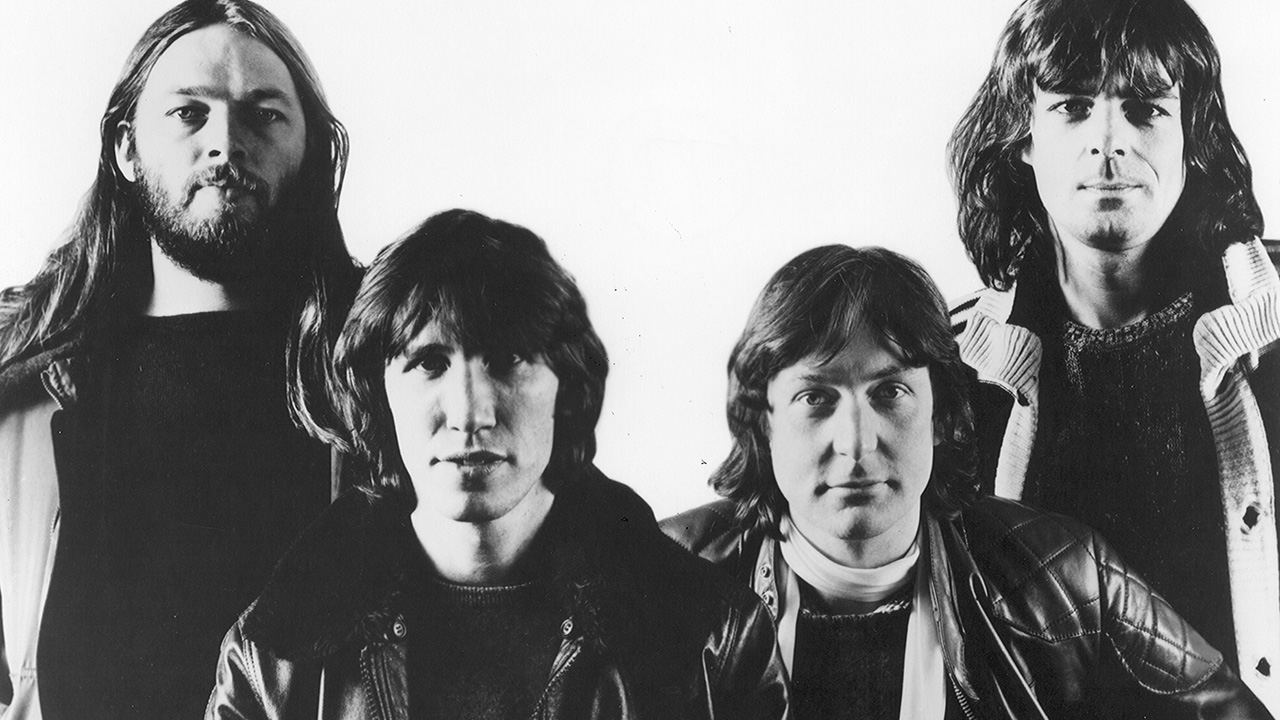
Pink Floyd 1970
(Image credit: Getty Images)

From the hell of an Italian trip to the heaven of Hyde Park, the year leading up to the release of Atom Heart Mother was a life-changing time for Pink Floyd. In 2016 Prog looked back at the events that helped shape the band’s first No.1 album.


“Ah, Friesians.” It was summer 1970 and LG Wood, managing director of EMI’s Record Division, was peering at the cover of Pink Floyd’s Atom Heart Mother. It was EMI policy for Wood to sign off on all EMI album sleeves, but here was a cover missing a title and the group’s name. Instead, there was just a cow in a field. Presuming there were words somewhere, Wood turned the sleeve over, only to find more cows. According to one eyewitness, “Ah, Friesians” was all the baffled MD could muster.

Three months later, Atom Heart Mother became Floyd’s first No.1 album. EMI’s powers that be already knew that strange-sounding hairy rock groups sold lots of records. Now, it seemed, they could do so without including their name or the album title on the cover. Just a cow in a field.

The band’s gargantuan seven-volume box set, The Early Years 1965-1972, dedicates an entire volume, Devi/Ation, to Atom Heart Mother and the Zabriskie Point soundtrack that inspired its title track. Here you’ll find the earliest known recording of the AHM suite, plus filmed performances from Hyde Park and St Tropez, and much more besides.

But Atom Heart Mother is probably better known for the cow than the music. Revisiting the album now is like entering a parallel universe inhabited by epic orchestral suites and songs created from the sounds of boiling kettles and frying bacon. Floyd would make better albums, but it remains the apotheosis of their experimental era – or as guitarist David Gilmour later described it, “Our weird shit.”


For the next release in the quiet details series, it’s my great pleasure to share with you a wonderful collaboration from the perfectly-matched pair of Adam Parkinson and Jordan Cohen, otherwise know as Dane Law & Chants, with Bonded Pairs

 Public announcement 26th August; full release 2nd September 2026.

Both have extensive bodies of solo work: Adam using deep programming skills with the likes of Max/MSP alongside deft guitar and production expertise to release on the likes of Opal Tapes, Blue Tapes, Quantum Natives and more; and Jordan, a vastly talented drummer and producer, on Hush Hush, Astral Plane Recordings and others.

Their previous collaboration, on The Trilogy Tapes, was a masterclass in human performance excellence and digital sonic manipulation - and Bonded Pairs builds on that in stunning fashion.

Hypnotic percussive structures and ever-evolving textures are the core of the album - realised by a range of acoustic instruments, and custom-built software processing.

The creative imagination on display here is truly something to behold - their tactile instrumental skills provide incredible source material, and their mastery of computer-based transformations allows them to shape these complex collages. Defying classification, this is an album of huge scope and inventiveness.

As they say:

Materials: guitar, drums, cello, saxophone, trumpet, balafon, and voice.
Transmuted digitally to access the ineffable.

Guitar and drums take centre stage, melodic and metrical - sampled, rearranged, merged into shifting rhythmical patterns that move in and out of focus. These are complimented by the textural beauty of the other instruments, giving harmonic depth to the pieces, and the arrangements’ true musical maturity.

Intricate polyrhythms, emotive diversity, ineffable soundscapes - the album as a whole is unique quiet details interpretation, and it’s an honour to share it with you.

Huge thanks to Dane Law & Chants, a fantastic addition to the series.

Thanks also to:
Greg Riss - additional drumming on ‘Paths to Leyton’ and ‘Drum Drone (Four Mallets)’
Contains samples of performances by:
Bossada - saxophone
Brian Grimm - cello
Charlie Palm - trumpet

The artwork was made as always influenced by the music and idea behind the album - originating from a photo from the pair which was then captured with analogue photography and processed here at quiet details studios.

As usual, the album is presented on the physical edition, a custom six-panel digipack with a separate fine art print too.

The CD also has a special long-form continuous mix of the album, unique and representing the music in its purest form.

Credits:
Music by Dane Law & Chants
Mastered by Alex at quiet details studios
Artwork by quiet details in collaboration with Dane Law & Chants
Design by quiet details
© quiet details 2026 all rights reserved


06 January 2026: Pink Floyd "Wish You Were Here 50"; The Third Mind: A Tribute to the Dreammachine

Be sure to follow KMXT FreeForm Radio on Facebook and Bandcamp and Spotify.  

You can now listen to the livestream of the show through the KMXT app; it's available through the Mac App Store or Google Play. The stream is also available at www.kmxt.org

Please support FreeForm Radio and KMXT by going to www.KMXT.org and pledging your support.

The music you hear on tonight's show is available on the artists' Bandcamp pages and websites. (links below) 

                    We urge you to support the musicians you hear on FreeForm Radio 

I am also hosting Rural Electric, this week spotlighting Ringo Starr's new country album, Look Up


Wish You Were Here has been a mainstay on all-time greatest albums lists for decades. The multi-Platinum-selling #1 hit record was Pink Floyd’s first to reach the top of the charts on both sides of the Atlantic, becoming the band’s fastest selling album. In 1973, The Dark Side of the Moon had taken Pink Floyd from a hugely successful breakout British band to one of the biggest rock groups on the planet. Wish You Were Here was the band’s powerful response to their newfound global fame.

Featuring the multi-part eulogy to Syd Barrett ‘Shine On You Crazy Diamond’, the hypnotic ‘Welcome To The Machine’, the scathing ‘Have a Cigar’ with its immortal line “Oh by the way, which one’s Pink?” famously sung not by Waters or Gilmour, but by non band-member Roy Harper, and the essential title track, Wish You Were Here is undoubtedly one of the most important album releases in the history of popular music.

The record’s themes of absence, isolation, transience, and comment on the insincerity of the music business are embodied in the iconic album artwork. The visual puns developed by Storm Thorgerson and Aubrey ‘Po’ Powell at Hipgnosis remain instantly recognisable visual statements today.

Remembering that time, Aubrey ‘Po’ Powell said:

“In the 1970s, album covers were equally as important as the music, because the cover helped to sell the record. Record stores would carry 10,000 different images in album sleeves, so what we were doing had to look different and stand out amongst the crowd.

I remember turning around to Storm and saying, how are we going to set a man on fire? Because there was no digital way of doing it in those days. He said, Po, you’re just going to have to do it for real. That was it.

One has to remember that Pink Floyd were the only band on EMI and Capitol Records who had the rights to the creative – in terms of album cover – besides the Beatles. That’s why we were allowed to do what we wanted. It was brilliant. Just the same way that Pink Floyd were a very inventive band at the time, so were Hipgnosis. We were determined to keep that abstract, enigmatic image alive and hence, we were able to do that for Pink Floyd.”

In 2025 the ardent support and fascination surrounding Pink Floyd’s music remains. The newly restored version of their groundbreaking 1972 film Pink Floyd at Pompeii – MCMLXXII stormed box offices around the world, with the live album debuting at #1 on the UK Albums Chart, marking the band’s first UK chart-topper in eleven years and the seventh in their career. The film was praised by critics and audiences the world over, with The Guardian describing it as a “mesmerically peculiar portrait of a band on cusp of greatness.” 50 years since its release, Wish You Were Here sounds as resonant and vital as ever, and in reaching this milestone deserves to be celebrated anew. This special anniversary edition allows fans, for the first time, to delve deeper into a pivotal moment in Pink Floyd’s history.


The Dreamachine, conceived in 1959 by Brion Gysin in collaboration with the mathematician Ian Sommerville, was an experiment in expanded consciousness. A flickering cylinder of light designed to be viewed with closed eyes, it sought to induce visionary states, to dissolve the boundaries of perception, and to reveal the inner landscapes of the mind. Gysin regarded it as the first work of art meant to be seen with the eyes shut, an inversion of traditional aesthetics, turning vision inward rather than outward. It was around the aura of the Dreamachine that Gysin’s creative alliance with William S. Burroughs deepened. Both artists shared an obsession with breaking down systems of control, linguistic, social, and perceptual. Gysin’s discovery of the cut-up technique became one of Burroughs’ most radical tools, just as Burroughs’ prose amplified Gysin’s explorations into altered states and the mechanics of thought. Together, they envisioned what they called The Third Mind: a new consciousness that could emerge from the fusion of two creative intelligences, transcending individuality and generating something other, stranger, and more powerful than either artist alone. This compilation invites contemporary musicians to pay tribute to that visionary partnership. Each track seeks to channel the spirit of experimentation, psychedelia, and radical perception that defined their work, whether through hypnotic repetition, immersive soundscapes, or altered states of sonic awareness. What emerges is a collective attempt to listen through the ears of The Third Mind itself, and to continue the experiment Gysin and Burroughs began more than half a century ago.

This release is an independent tribute inspired by the work of Brion Gysin, William S. Burroughs and Ian Sommerville. It is not affiliated with, sponsored or endorsed by their estates.
  

credits

releases January 15, 2026

REVIEWS

Ver Sacrum 
www.versacrum.com/vs/2026/01/the-third-mind-a-sonic-tribute-to-the-dreamachine-various-artists.html

BizarreChats 
bizarrechats.blogspot.com/2026/01/unexplained-sounds-third-mind-sonic.html


Related release: a previous Unexplained Sounds Group compilation dedicated to William S. Burroughs’ cut-up technique: 
unexplainedsoundsgroup.bandcamp.com/album/cut-up-deconstructing-w-s-burroughs

FreeForm thanks  Raffaele Pezzella for a complimentary copy of this release.

Curated and mastered by Raffaele Pezzella.
Layout by Matteo Mariano. 
Published by Unexplained Sounds Group.
Cat. Num. USG114.
© 2026 All rights reserved.

license

all rights reserved

31 December 2024: A Pink Floyd New Year's Eve

Be sure to follow KMXT FreeForm Radio on Facebook and Bandcamp.  

Please support FreeForm Radio and KMXT by going to www.KMXT.org and pledging your support.

The music you hear is available on the artists' Bandcamp pages, websites, and Spotify. 

We urge you to support the musicians you hear on FreeForm Radio.

Beginnning at 9 pm Alaska Time, we'll be playing Pink Floyd nonstop until the two minute countdown to Midnight followed by Auld Lang Syne and one final Pink Floyd track.

Meddle is the sixth studio album by the English rock band Pink Floyd, released by Harvest Records on 5 November 1971 in the United Kingdom.[3] The album was produced between the band's touring commitments, from January to August 1971 at a series of locations around London, including EMI Studios (now Abbey Road Studios) and Morgan Studios.

With no material to work with and no clear idea of the album's direction, the band devised a series of novel experiments which eventually inspired the album's signature track "Echoes". Although the band's later albums would be unified by a central theme chosen by Roger Waters, and thematically consistent lyrics written entirely by Waters, Meddle was a group effort with Waters contributing primarily to the lyrics and the bass. It is considered a transitional album between the Syd Barrett-influenced group of the 1960s and the Waters-led era of the 1970s.[4] Fans often refer to this album, especially "Echoes", as the first instance of the group achieving their musical potential.

The Dark Side of the Moon is the eighth studio album by the English rock band Pink Floyd, released on 1 March 1973 by Harvest Records in the UK and Capitol Records in the US. Developed during live performances before recording began, it was conceived as a concept album that would focus on the pressures faced by the band during their arduous lifestyle, and also deal with the mental health problems of the former band member Syd Barrett, who had departed the group in 1968. New material was recorded in two sessions in 1972 and 1973 at EMI Studios (now Abbey Road Studios) in London.

The record builds on ideas explored in Pink Floyd's earlier recordings and performances, while omitting the extended instrumentals that characterised the band's earlier work. The group employed multitrack recording, tape loops, and analogue synthesisers, including experimentation with the EMS VCS 3 and a Synthi A. The engineer Alan Parsons was responsible for many aspects of the recording, and for the recruitment of the session singer Clare Torry, who appears on "The Great Gig in the Sky".

The Dark Side of the Moon explores themes such as conflict, greed, time, death, and mental illness. Snippets from interviews with the band's road crew and others are featured alongside philosophical quotations. The sleeve, which depicts a prismatic spectrum, was designed by Storm Thorgerson in response to the keyboardist Richard Wright's request for a "simple and bold" design which would represent the band's lighting and the album's themes. The album was promoted with two singles: "Money" and "Us and Them".

The Dark Side of the Moon has received widespread critical acclaim and is often featured in professional listings of the greatest albums of all time. It brought Pink Floyd international fame, wealth and plaudits to all four band members. A blockbuster release of the album era, it also propelled record sales throughout the music industry during the 1970s. The Dark Side of the Moon is certified 14× platinum in the United Kingdom, and topped the US Billboard Top LPs & Tape chart, where it has charted for 990 weeks. By 2013, The Dark Side of the Moon had sold over 45 million copies worldwide, making it the band's best-selling release, the best-selling album of the 1970s, and the fourth-best-selling album in history.[3] In 2012, the album was selected for preservation in the United States National Recording Registry by the Library of Congress as being "culturally, historically, or aesthetically significant". It was inducted into the Grammy Hall of Fame in 1999.[4]


Wish You Were Here is the ninth studio album by the English rock band Pink Floyd, released on 12 September 1975 through Harvest Records in the UK and Columbia Records in the US, their first for the label. Based on material Pink Floyd composed while performing in Europe, Wish You Were Here was recorded over numerous sessions throughout 1975 at EMI Studios in London.

The lyrics express alienation and criticism of the music business. The bulk of the album is taken up by "Shine On You Crazy Diamond", a nine-part tribute to the Pink Floyd co-founder Syd Barrett, who had left seven years earlier due to his deteriorating mental health. Barrett coincidentally visited during the recording. As with their previous release, The Dark Side of the Moon (1973), Pink Floyd employed studio effects and synthesisers. Guest singers included Roy Harper, who provided the lead vocals on "Have a Cigar", and Venetta Fields, who added backing vocals to "Shine On You Crazy Diamond". To promote the album, Pink Floyd released the double A-side single "Have a Cigar" / "Welcome to the Machine".

Wish You Were Here was certified gold in the UK and the US in its year of release and topped the charts in several European countries. By 2004, it had sold an estimated 13 million copies worldwide. It initially received mixed reviews; critics found its music uninspiring and inferior to Pink Floyd's previous work. It was later acclaimed as one of the greatest albums of all time, appearing on lists including Rolling Stone's list of the 500 greatest albums at which it was ranked at #264 in 2021. It was cited by the keyboardist, Richard Wright, and the guitarist, David Gilmour, as their favourite Pink Floyd album


Animals is the tenth studio album by the English rock band Pink Floyd, released on 21 January 1977,[2] by Harvest Records and Columbia Records. Pink Floyd produced it at their new studio, Britannia Row Studios, in London throughout 1976. The album continued the long-form compositions that made up such previous works as Meddle (1971) and Wish You Were Here (1975).

A lyrical departure from Pink Floyd's previous albums, Animals is a concept album that focuses on the sociopolitical conditions of mid-1970s Britain. Tension within the band during production culminated in the firing of the keyboardist, Richard Wright, two years after the album's release. The cover, conceived by the bassist and lead songwriter, Roger Waters, and designed by their long-time collaborator Storm Thorgerson, shows an inflatable pig floating between two chimneys of Battersea Power Station.

Pink Floyd released no singles from Animals but promoted it through the In the Flesh tour. Waters' agitation with audiences during this tour inspired their next album, The Wall (1979). Animals reached number 2 in the UK and number 3 in the US. It initially received mixed reviews, but gained more favourable reviews in later years, and is considered one of Pink Floyd's best works.

All album information taken from articles on Wikipedia.com


30 May 2023: Yes "Mirror to the Sky"; Pink Floyd "The Dark Side of the Moon" 50th Anniversary remaster; Michael Bonaventure "Retrospective"

Be sure to follow KMXT FreeForm Radio on Facebook and Bandcamp.  

Please support FreeForm Radio and KMXT by going to KMXT.org and pledging your support - 

You can still support the Spring Fund Drive: Donate Now!

The music you hear on tonight's show is available on the artists' Bandcamp pages and websites. (links below) 

We urge you to support the musicians you hear on FreeForm Radio.

I also host the Rural Electric (Mostly) Country Music show Tuesday from 7-9 pm ADT

This week featuring Aoife O'Donovan


Mirror to the Sky is the twenty-third studio album by English progressive rock band Yes, released on 19 May 2023 by InsideOut Music and Sony Music.[2] It is their first studio album with American drummer Jay Schellen as a full-time member following the death of long-time Yes drummer Alan White in 2022, and to whom the album is dedicated.[3]

Yes started work on the album shortly before the release of The Quest, their previous album, in October 2021. Like its predecessor, guitarist Steve Howe resumed his role as producer on Mirror to the Sky and the FAMES Orchestra in North Macedonia provide orchestral arrangements by Paul K. Joyce on some songs. 

Yes – Mirror To The Sky: "the best Yes album in more than 20 years"

No Jon Anderson, Chris Squire or Alan White? No problem for Yes. Prog’s great survivors hit a late-career upswing on Mirror To The Sky

With every studio recording, live album or tour announcement, there’s always a faction of fans who will turn up on a corner of the internet waving their ‘No Jon Anderson, No Yes’ banners. Their zeal is only matched by the nearby counter-demonstration shaking their ‘No Peter Banks, No Yes’ placards.

But time and events have moved on and maybe the ‘No Anderson’ contingent should too. In the aftermath of the singer’s unceremonious departure 15 years ago, we’ve since lost Chris Squire and Alan White, a stark reminder, should it be needed, that life is really too short to spend time grinding gears over something we have no control over. Rather than exercising well-worn prejudices and allowing expectations to become self-fulfilling prophecies, isn’t it better to approach a new album with an open mind? 

If 2021’s The Quest represented a return to some kind of form after the bland torpor of 2014’s Heaven & Earth, Mirror To The Sky feels like another useful step forward in Yes’ apparently never-ending story. There’s a good reason they released Cut From The Stars as a digital single ahead of the album: it has more hooks in it than an angler’s bag. With a cascading string motif; vibrant rays of organ; spiky, undulating bass; bubbling guitars; dead-ahead drumming and ecstatic skipping vocals, it moves with determined energy and purpose. Setting out the stall of a band that have now been fully rejuvenated with the installation of drummer Jay Schellen, it’s a track that has urgency and power in abundance. Or, to put it another way, it fucking rocks. 

Those catchy qualities continue with All Connected – its expansive feel seamlessly unrolls from one section to another, making the musical connectivity work with consummate ease. While taking disparate elements and welding them into something functional and cohesive is pretty much what Yes are best known for, there’s an argument that it’s not been done as elegantly as this for quite some time. If the chorus of Luminosity sounds, at times, like it might have been rejected by the local Christian Fellowship for being too happy-clappy, it’s at least bookended with an engagingly upbeat arrangement. The same cannot be said for the plodding dreariness of Living Out Their Dream, an unimaginative rocker whose by-the-numbers presence here is baffling.

That lapse of judgement is mercifully brief and the title track restores momentum. The piece showcases orchestral embellishments by Paul K Joyce, whose work also graced The Quest. Mid-tempo rather than magisterial, it nevertheless works well, with ethereal violin harmonics adding a chilly trail in the wake of Howe’s contemplative fretwork. The guitarist’s soloing throughout the track is especially good. At 75 years old he might have slowed down in comparison to the flash of his youth, but he demonstrates the wisdom of knowing that, in this case, a leaner, cleaner melodicism will serve the song all the better. As principal soloist and producer, Howe is ultimately free to overdub as many guitars onto a track as he sees fit without fear of anyone telling him otherwise, yet here he opts for a restrained approach that benefits the album overall. 

Yes’ internecine politics in the past have sometimes reduced the album-making process into a passive-aggressive grudge match, wherein the band are only able to work at the speed of the unhappiest member. By contrast, this line-up has publicly stated that the spirit of cooperation and mutual support evident during The Quest has continued to flourish. Though it’s hard to objectively quantify, there’s a sense that everyone being on the same page has brought optimism and coherence to the music. Jon Davison’s charming ballad Circles Of Time, which gently closes the album, though delicate on the surface, comes with a real inner strength that’s due to the simplicity of its arrangement and uncluttered sureness of its production.  

As with The Quest, this album also comes with a three-track bonus disc. The best of these is the middling Unknown Place. With its Hammond organ wig-out and solo cowbell section it seems designed to provide some clap-along crowd participation when Yes next get back on the road.

The long tail of Yes’ inventiveness during the 1970s burns so intensely to this day that it’s inevitable that the current band will likely always be judged against those past glories. While Mirror To The Sky doesn’t scale those early innovative heights and is unlikely to change the musical weather in the way the band once did, when judged on its own merits, this is a set that stands as the best Yes album in more than 20 years. Maybe it’s time to put down the placards and listen.


 A few weeks ago we featured a live 1974 recording of DSotM; tonight we spotlight the 50th Anniversary remastered recording of the original release.

The Dark Side of the Moon 50th Anniversary is a box set reissue of British progressive rock band Pink Floyd's original 1973 album. It was released on 24 March 2023 by Pink Floyd Records. Five digital-only singles were released to support the set. 

The Dark Side of the Moon is the eighth studio album by the English rock band Pink Floyd, released on 1 March 1973 by Harvest Records. Developed during live performances before recording began, it was conceived as a concept album that would focus on the pressures faced by the band during their arduous lifestyle, and also deal with the mental health problems of former band member Syd Barrett, who departed the group in 1968. New material was recorded in two sessions in 1972 and 1973 at EMI Studios (now Abbey Road Studios) in London.

The record builds on ideas explored in Pink Floyd's earlier recordings and performances, while omitting the extended instrumentals that characterised the band's earlier work. The group employed multitrack recording, tape loops, and analogue synthesisers, including experimentation with the EMS VCS 3 and a Synthi A. Engineer Alan Parsons was responsible for many of the sonic aspects of the recording, and for the recruitment of session singer Clare Torry, who appears on "The Great Gig in the Sky".

The Dark Side of the Moon explores themes such as conflict, greed, time, death and mental illness. Snippets from interviews with the band's road crew and others are featured alongside philosophical quotations. The sleeve, which depicts a prismatic spectrum, was designed by Storm Thorgerson in response to keyboardist Richard Wright's request for a "simple and bold" design which would represent the band's lighting and the album's themes. The album was promoted with two singles, "Money" and "Us and Them".

The Dark Side of the Moon is among the most critically acclaimed albums and often features in professional listings of the greatest of all time. It brought Pink Floyd international fame, wealth and plaudits to all four band members. A blockbuster release of the album era, it also propelled record sales throughout the music industry during the 1970s. The Dark Side of the Moon is certified 14 times platinum in the United Kingdom, and topped the US Billboard Top LPs & Tape chart, where it has charted for 981 weeks. As of 2013, The Dark Side of the Moon has sold over 45 million copies worldwide, making it the best-selling album of the 1970s and the fourth-best-selling album in history.[4] In 2012, the album was selected for preservation in the United States National Recording Registry by the Library of Congress as being "culturally, historically, or aesthetically significant".


The music in this new collection of Bonaventure’s work since 2017 displays the ongoing synthesis and/or particularisation of genres, extra- musical influences and fields of intuitive awareness that have always been at work in his music. All of these being subject to the natural flow of evolution that comes through continual artistic exploration never to be constrained by convenient labels such as ‘classical’, ‘experimental’ ‘avant garde’ or ‘dark ambient’ etc. For example, a lot of the music in his endless cycle of ‘Preludes, Interludes & Postludes’ for organ is informed as much by phenomena that occur in electronic & digital sounds and processes as it is by the splendour, gestures and harmonic idioms of ‘normal’ contemporary organ music. His natural inclination to explore both fields simultaneously - electronic & acoustic - is rooted in his youth when he was playing on a Hammond organ with Leslie speaker, and a basic synthesiser, as well as learning to play the ‘real’ organ and exploring the (then) contemporary repertoire that fascinated and inspired him to create. In this regard, his main tool was the recording of improvisations and sonic explorations, not just with the organ but with anything that potentially had music in it. And it still is. The process of recording and transcribing is the very bedrock of his...  more

credits

released May 25, 2023

Michael Bonaventure (b. 1962, Edinburgh), composer, organist and collaborator in new and experimental music projects; based in Edinburgh & Amsterdam.
In recent times he has been producing work in the Dark Ambient field of electronica, as exemplified in the CD album In Tenebris Ratione Organi, released in 2019 by Eighth Tower Records. An earlier survey of his electronic & organ music, Works 2008 - 2017, was released on the Unexplained Sounds Group label in 2017, and in 2020 he co-created with the Italian guitarist & synthesiser musician Loo(p)cy (Lucia Caiazza) a new album entitled Across The Blood, released digitally in October 2020. Most recently he has formed a duo,’PNEUMA’, with the Scottish-based flautist, composer & improviser Richard Craig in which a new dimension of artistic practice is being explored through the synergy of flute, organ and amplified sounds in new compositions, improvisation and the adaptation of existing repertoire. Bonaventure’s own sonic universe derives its inspiration from mysticism and ritual, natural and imaginary worlds, astronomical and supernatural phenomena; much of his work is rooted in a personal kind of ‘adapted minimalism’ and in improvisation.
Recent works are: Omega (2023) for organ & fixed media, Prayer & Exaltation (2022) for organ, Odd, Even & December Union (2021) for music box, both written for Joseph Kudirka; Mavisbank (2021), an electronic track created for Hauntology in the UK, a CD album released in December 2021 by Eighth Tower Records; The Land Of Silence (2021), a setting of Ernest Dowson’s poem “Beata Solitudo” for soprano, live electronics & organ, premiered in MontrĆ©al in May 2021 by Kimberley Lynch & Adrian Foster; an adaptation of Giant Silver (a track from In Tenebris Ratione Organi) with new material for organ, premiered by Lauren Redhead & Alistair Zaldua at the BBC Tectonics Festival in Glasgow in 2021; and Giant Glass Green (2020), an electronic work commissioned by Earth World Collaborative and funded by Canada Council for the Arts. A number of his electronic works have been used in video art created by the Dutch-based artist Thomas Mohr and shown at various film/video art festivals in Europe in recent years, including at Berlin Atonal.
His music has been played in Canada, USA, Russia, UK, New Zealand, France, Spain, Germany, Belgium & The Netherlands as well as on BBC Radio 3, Concertzender (Netherlands), Radio Onda Rossa (Italy) and Resonance Extra FM.
As an organ soloist (with and without electronics) Bonaventure is also a seasoned interpreter of new & experimental music, with innumerable composer collaborations since the early 1980s. To date he has given over 200 premiĆØres and concertized in churches, cathedrals, universities and at festivals throughout the UK, in Europe & USA, on BBC Radio 3 & Radio Scotland, and on 7 solo CDs. These include four volumes of ‘Contemporary British Organ Music’ on the sfz label and the later organ cycles of Olivier Messiaen for Delphian Records, including a widely-acclaimed rendition of the massive Livre du Saint Sacrement, released in 2008.


Published by Unexplained Sounds Group
Music by Michael Bonaventure
Mastering by Raffaele Pezzella (a.k.a. Sonologyst)
Artwork by Christian Voyce
© 2023. All rights reserved. 
Our thanks to Raffaele for providing a copy of this release to FreeForm Radio.