
Be sure to follow KMXT FreeForm Radio on Facebook and Bandcamp.
Please support FreeForm Radio and KMXT by going to KMXT.org and pledging your support.
The music you hear on tonight's show is available on the artists' Bandcamp pages and websites and Spotify. (links below)

Review by Prog Mind
Polish progressive rock continues to be a force, and so much of it is top tier. Amarok is back with a new album called Hope, which releases on April 5th. It continues the trend of excellent Polish releases.
Amarok have been around for quite some time now, since 1999, though with a lengthy hiatus in the middle. Still, their output over the last 8 years has been remarkable. The current lineup includes Michał Wojtas on vocals, guitars, keyboards, percussion, and e-drum; Kornel Popławski on bass, violin, cello, and vocals; Marta Wojtas on backing vocals, gong, and percussion; and Konrad Zieliński on drums and vocals.
Amarok has some of the typical traits of Polish prog. You’ll hear the throbbing bass front and center, the darker atmospheres, and the emotional guitar solos. They don’t end up sounding like everyone else, though, because of how pure and innocent and crystal-clear their sound is. Part of that has to do with Michał’s fantastic vocal performance, but it’s also in the way their music uses space, layers, and percussion effectively and distinctly.

You can hear this on all their albums. I’m most acquainted with 2004’s Metanoia and onwards, especially 2017’s amazing Hunt and 2021’s earworm Hero. Hope is most like Hero, I would say, as the band continues to find their own niche and their own style. This album, I would say, has a little more edge than older ones, more guitar and more riffs. But it still has that ensemble and almost mystical feeling to it, as well, and the band’s signature eccentricity.
The album features Michał on vocals, but you will also hear Kornel and Konrad on lead vocals on one track, respectively. The album puts both of those tracks smack dab in the middle, which I find a fitting and interesting structure. Both halves seem pretty equal to me, with each half having some towering highlights. I will say, though, that this album is a grower—it took several listens to grab me.
I absolutely adore the opener “Hope Is”; I love the voiceover and spacey vibes and the synth melodies. Such a great song. “Stay Human” is a quirky, rhythmic, circular sort of tune that can feel repetitive, but when I understood what they were trying to do, I began to like it. “Insomnia” is one the most razor-edged songs I think the band as made; it has plenty of emotion and all that, but the last half is like a driving force of anxious guitars. “Trail” follows and is a favorite—I like how it marches along with electronica, hovering vocals, and Oldfield-style guitar work, and then the second half brings a wave of heaviness that is not typical for the band. Sounds great!

The next two tracks offer a detour in vocals. Konrad ends the first half with “Welcome”, a piece that is casual and beautiful—I love the drumming. Kornel begins the second half with “Queen”, a quirky and colorful piece that slowly burns its way into multiple layers of stylish violin, floating vocals, and leering rhythms. Such a cool song. Of course, the instrumental “Perfect Run” comes next and is absolutely astonishing; it is well-named with how it drives and flows perfectly. It is such a satisfying piece.
The last three songs are good ones. I like “Don’t Surrender” for its emotional lyrics and guitar work. “Simple Pleasures” is a reserved song that is mostly vocals and some guitar; it might take the wind out of the album’s sails somewhat, but it is beautiful, nonetheless. Finally, “Dolina” is a textured, short closer which I love; it is gorgeous and Michał emotes so well on it, and in Polish. I do feel like the last three tracks being mostly reserved hurts the album overall, but that is just a track order issue.
Amarok hasn’t made a weak album, and this one has all the beauty and variety I have come to expect from them. Michał’s vocals are strong once again, as is his guitar work, but the whole band puts in a performance that will stay with me. And for an album called Hope, it certainly does leave you feeling uplifted and confident.
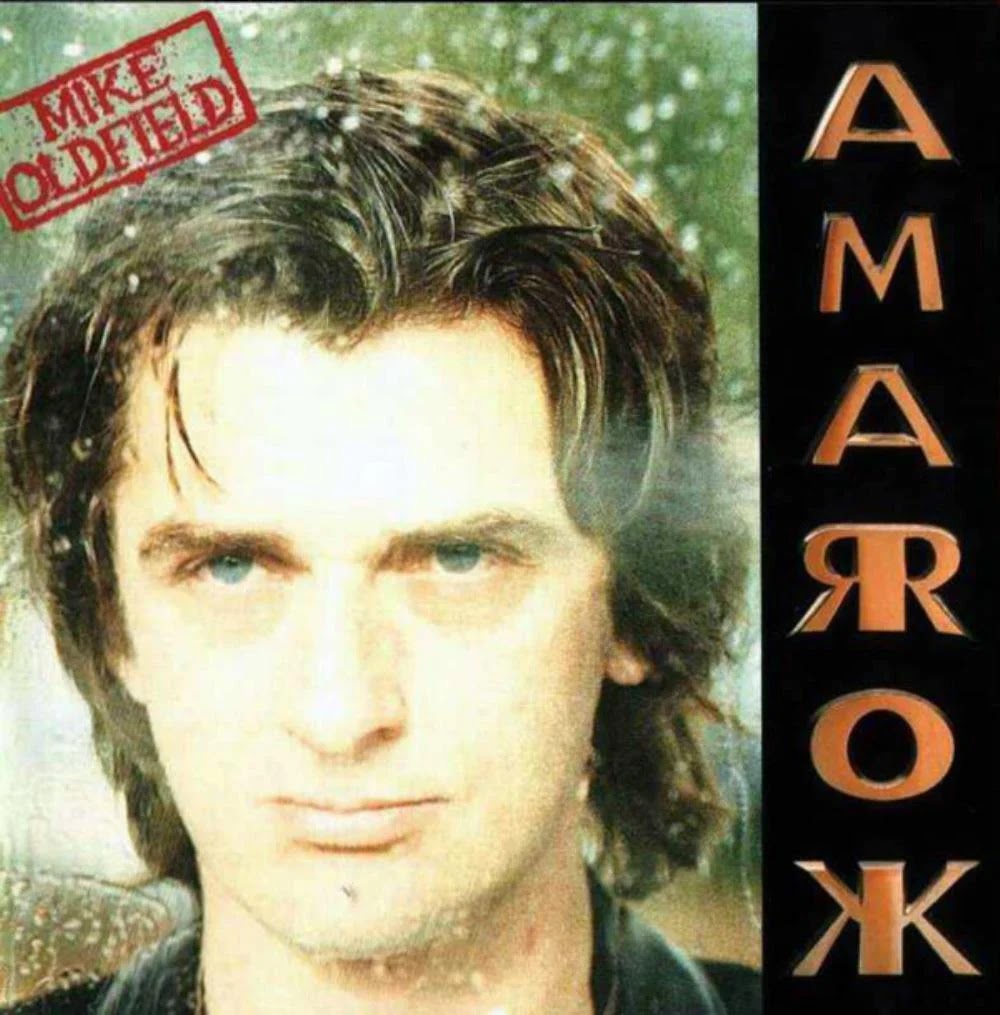
Amarok is the thirteenth studio album by English multi-instrumentalist and songwriter Mike Oldfield, released in May 1990 by Virgin Records. Oldfield originally conceived it as an "angry protest album", showcasing his musical technique.[2] It is presented as a single sixty-minute track of continuous, uninterrupted but constantly changing music.
In July 1989 Oldfield released Earth Moving, his twelfth album for Virgin Records. By this time, his relationship with the label had become increasingly fraught as a result of disagreements over his contract, royalties, and the lack of effort in promoting his albums. Earth Moving was an album whereby he "listened to Virgin totally" in regards to its musical direction, which became a success in continental Europe, but received a disappointing reaction in England, for which Oldfield received "some flak" from Virgin over the matter.[3] Oldfield was now required to deliver two more albums as part of his Virgin contract and in the summer of 1989, he started on one with the aim of pleasing his fans while annoying Virgin executives. Oldfield deemed Amarok his "personal revenge" for Virgin's lack of support.[4]
The idea for Amarok originated in August 1989, when Oldfield recorded a session for broadcast on BBC Radio 1 that included a 7-minute excerpt of his debut album Tubular Bells (1973) performed by himself. Oldfield had fun in the process, which inspired him to make Amarok in such a way.[3] When Oldfield started to write and arrange "Amarok", he ignored the pressures of delivering commercial material for Virgin and instead "let it all come out without any interference [...] I felt I was getting ideas from somewhere inside me, and six months later I had a whole album."[3] He decided upon an album that contained one 60-minute piece which, unlike his previous long tracks, was not split into sections. Such a format would create difficulty for Virgin to market or promote with radio airplay. He avoided letting a theme become something that Virgin might have identified suitable for a single, and developed ideas by "imagining sound, not picture".[3]
Oldfield's contract with Virgin expired on 1 January 1991.[5]




 Posts
Posts


